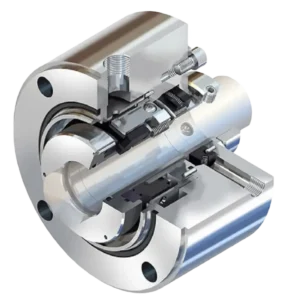
Product Overview
What is a Pusher Mechanical Seal?
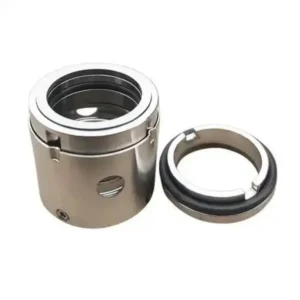
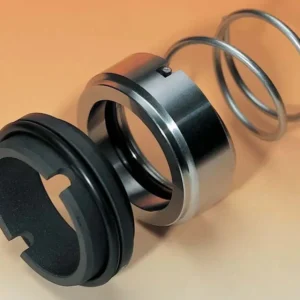
A pusher mechanical seal uses a spring or springs to push the rotating face against the stationary face while a dynamic secondary seal (O-ring) moves axially with the rotating assembly. Pusher seals are distinct from bellows (non-pusher) designs because the secondary seal is dynamic and travels with the face. They are widely used where modular replacement, straightforward construction and robust face loading control are required.
Common aliases: Pusher Seal, pusher-type mechanical seal, single-spring pusher seal, cartridge pusher seal.
Core Features & Design Options
Key features
-
Pusher (spring-loaded) design — compensates for face wear by axial movement of the seal head.
-
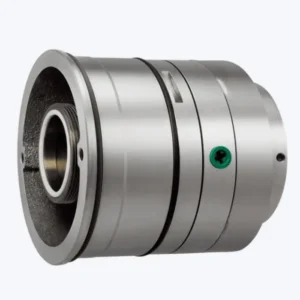
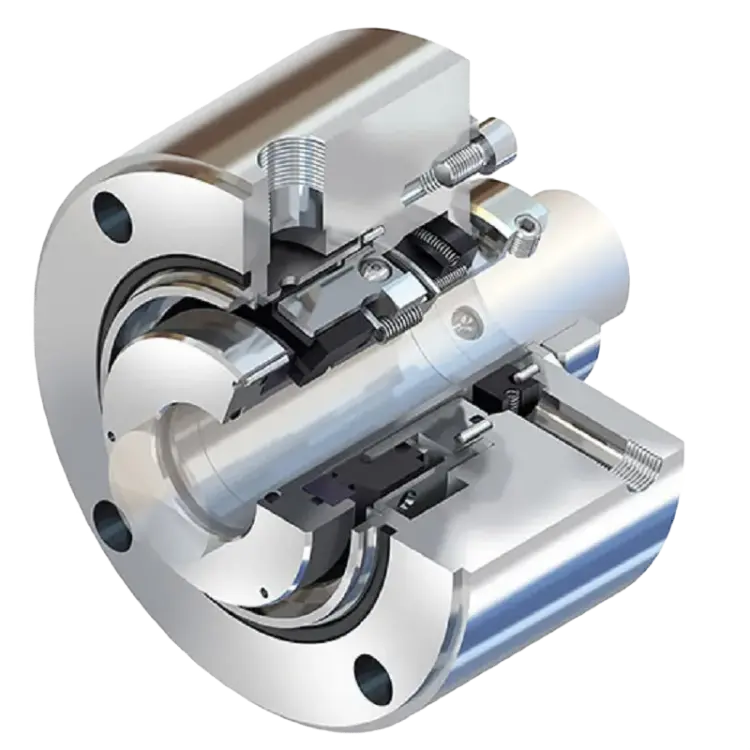
Single-spring, multi-spring and cartridge variants — cartridge versions reduce installation error and downtime.
-
Modular serviceability — replaceable face sets, elastomer kits and springs simplify repairs.
-
Wide material selection — carbon, silicon carbide (SiC), tungsten carbide (TC), ceramics, stainless steel hardware; elastomers include NBR, HNBR, FKM (Viton), EPDM for media compatibility.
Technical Specifications
For part-specific dimensions and exact pressure/temperature limits refer to the downloadable datasheet linked below.
-
Seal type: Pusher mechanical seal (single-spring, multi-spring, cartridge pusher).
-
Common shaft diameters (stock): 12, 16, 20, 25, 32, 40, 50, 63, 80, 100, 125, 130 mm.
-
Typical maximum recommended dynamic pressure: up to ~17 bar (247 psi) for many pusher O-ring designs — application dependent; consult material & plan.
-
Temperature range (dependent on face and elastomer choice): commonly −40 °C to +230 °C for standard selections; high-temperature options exist with specialized materials.
-
Speed limits: depend on face combination and lubrication; many pusher seals are rated up to 20–25 m/s surface speed for common face pairs (consult datasheet).
-
Face combinations available: Carbon vs SiC, SiC vs SiC, Carbon vs Ceramic, TC vs Carbon (select by abrasiveness, temperature, and media).
Common Sizes & Selection Guide
Typical stocked shaft sizes (mm / inches)
| Shaft dia (mm) | Approx. inch |
|---|---|
| 12 | 0.47″ |
| 16 | 0.63″ |
| 20 | 0.79″ |
| 25 | 0.98″ (1″) |
| 32 | 1.26″ |
| 40 | 1.57″ |
| 50 | 1.97″ |
| 63 | 2.48″ |
| 80 | 3.15″ |
| 100 | 3.94″ |
| 125 | 4.92″ |
| 130 | 5.12″ |
Selection inputs required for an accurate quote: shaft diameter, pump OEM/model, stuffing box dimensions or existing seal part number, fluid media, temperature, operating pressure, shaft speed (RPM), preferred face/elastomer materials.
Materials & Face Comparison
Recommended pairings by service
-
Carbon (rotor) / Silicon Carbide (stationary): good run-in behavior; economical for many clean liquids.
-
Silicon Carbide / Silicon Carbide: excellent wear and corrosion resistance — recommended for abrasive, high-temperature services.
-
Tungsten Carbide / Carbon: high abrasion resistance; suited to heavy duty/high wear applications.
Face material comparison table
| Property | Carbon | Silicon Carbide (SiC) | Tungsten Carbide (TC) | Ceramic |
|---|---|---|---|---|
| Hardness | Low | High | Very high | High |
| Wear resistance | Moderate | High | Very high | High |
| Brittleness | Low | Moderate | Moderate-high | High |
| Cost | Low | Medium | High | Medium |
| Best for | Clean lubricating liquids | Abrasive/corrosive media | Heavy-duty abrasive | Corrosion-resistant, moderate wear |
(Choose elastomer according to media: NBR for hydrocarbons, FKM for high temp/chemical resistance, EPDM for hot water/wastewater.)
Typical Applications & Pump Types
Industries
-
Water treatment & distribution
-
Wastewater & sewage handling
-
Petrochemical & chemical processing (low-to-moderate pressure streams with compatible materials)
-
HVAC & chilled water systems
-
General industrial services: cooling, boiler feed, lubrication circuits
Pump types
-
End-suction centrifugal pumps (ISO/ANSI)
-
Close-coupled pumps
-
Vertical pumps (with correct shaft sleeve/adapter)
-
Some rotary equipment where axial movement is accommodated
Performance, Installation & Maintenance
-
Installation: Cartridge pusher seals are recommended where downtime reduction and installation consistency are priorities. Field compaction and correct set height are critical for service life.
-
Flush & support plans: For hot, solids-laden or volatile services use an appropriate API/ISO flush plan to maintain lubrication and cooling.
-
Maintenance: Keep spare face sets and elastomer kits for common shaft sizes on site; inspect shaft sleeve and surface finish before installation.
Advantages of Pusher Mechanical Seals
-
Easier face replacement and field serviceability — lower repair time and cost.
-
Flexible for a broad range of pump models and service conditions.
-
Cartridge options reduce risk of installation error and shorten downtime.
-
Wide availability of face and elastomer combinations to match media.
Pusher vs Non-Pusher / Balanced Options
| Characteristic | Pusher Seal | Non-Pusher (Bellows) Seal | Balanced Seal |
|---|---|---|---|
| Secondary seal motion | Dynamic (O-ring moves) | Static (bellows provides flexibility) | Can be pusher or non-pusher; balanced face loading |
| Best for | General service, easy field service | Services prone to hang-up avoidance, higher temperatures (with proper bellows) | High pressure or low-lubricity fluids |
| Serviceability | High (replaceable cartridges/face sets) | Often less modular but avoids dynamic O-ring slide issues | Used when face load reduction is necessary |
| Pressure capability | Good within material limits; many designs rated up to ~17 bar | Varies; bellows designs have different pressure limits by size | Preferred for higher pressure duties. |
Downloadable Resources
FAQ
Q1: When should I pick a pusher seal vs a bellows (non-pusher) seal?
A: Choose a pusher seal when field serviceability, cartridge retrofit options and a wide material selection are priorities. Choose a bellows (non-pusher) when axial hang-up from a moving secondary seal is a concern or where a static secondary arrangement is required.
Q2: What details do you need to provide a firm quote?
A: Shaft diameter, pump OEM & model (or seal part number), operating pressure, operating temperature, fluid media, shaft speed (RPM), and whether cartridge or component style is preferred.
Q3: Are pusher seals suitable for wastewater / sewage?
A: Yes — but select face materials and flush plans to handle solids and abrasives. SiC faces with appropriate flush/plan are commonly used.
Q4: What is the expected life of a pusher mechanical seal?
A: Life depends on face material, lubrication, solids content, temperature, and proper installation. Typical life for well-matched materials under recommended conditions is measured in thousands of operating hours; specify duty cycle for a more precise estimate.
Q5: Do you offer cartridge interchange kits for retrofits?
A: Yes — we supply cartridge retrofit options for common ANSI/ISO pump models to minimize downtime and installation error.
E-E-T-A
-
Experience: Our mechanical-seal team supports pump sealing for municipal, chemical and petrochemical clients with on-site support and retrofit programs.
-
Expertise: Seal selections are validated by experienced engineers using OEM cross-reference data and industry selection guides.
-
Authoritativeness: Materials, dimensional drawings and QA procedures are documented for each shipment; test records available on request.
-
Transparency: Material declarations, recommended operating envelopes and service limitations are provided for every quote; we recommend sharing pump OEM details to ensure correct selection.
Why choose our Pusher Mechanical Seals
-
Fast stock for common sizes (12–130 mm).
-
Cartridge and component options to match your maintenance strategy.
-
Multiple face/elastomer pairings to fit liquids from clean water to petrochemical streams.
-
Technical support for selection, dimensional confirmation and on-site troubleshooting.
Contact & Ordering
Hengshui Aohong — Mechanical Seals Division
-
Email: sales@aohongglobal.com (for datasheet requests and fast quotes)
-
Phone: +(86) 153 7318 1024 (please replace with your official number)