
Stationary Seal Rings — Precision Stationary Seats for Mechanical Seals
What / Why — Stationary seal rings (stationary seats) form the stationary sealing face in mechanical seals. Correct material, tolerance and mounting determine face life, leakage performance and interchangeability. Useful search terms: stationary seal rings, stationary seal seats, stationary seal ring suppliers, mechanical seal stationary rings pdf.
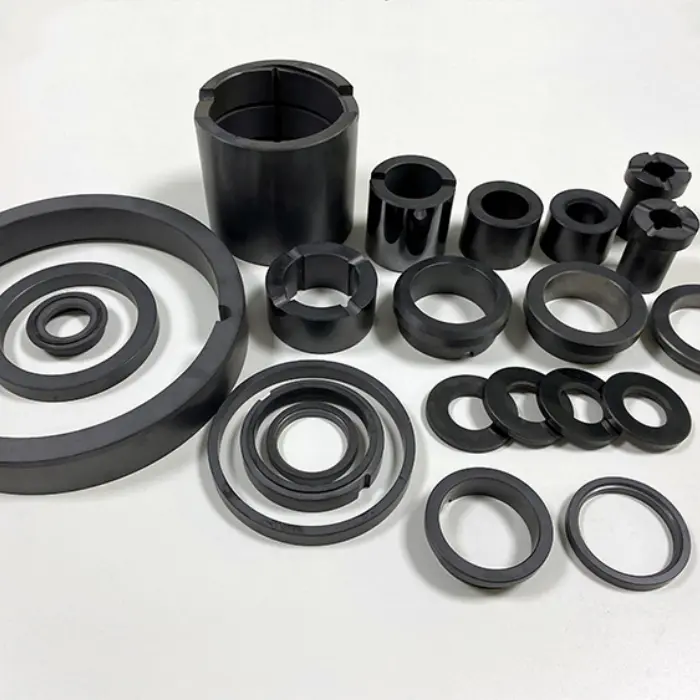
Executive Summary
Stationary seal rings are precision, non-rotating components that partner with rotating faces to create the primary seal in mechanical seal assemblies. Material selection (carbon, SiC, ceramic, TC, PTFE) and ring format (monolithic, split, PTFE-lined) define suitability for corrosion, abrasion and sanitary demands. This page provides concise guidance for procurement, engineering and maintenance.
What is a Stationary Seal Ring?
A stationary seal ring (stationary seat) is a precisely lapped ring installed in the gland, seal housing or adapter. It presents a flat sealing surface that mates with the rotating face. Although passive, its geometry, mounting and material control leakage rate, wear, and heat generation at the face interface.
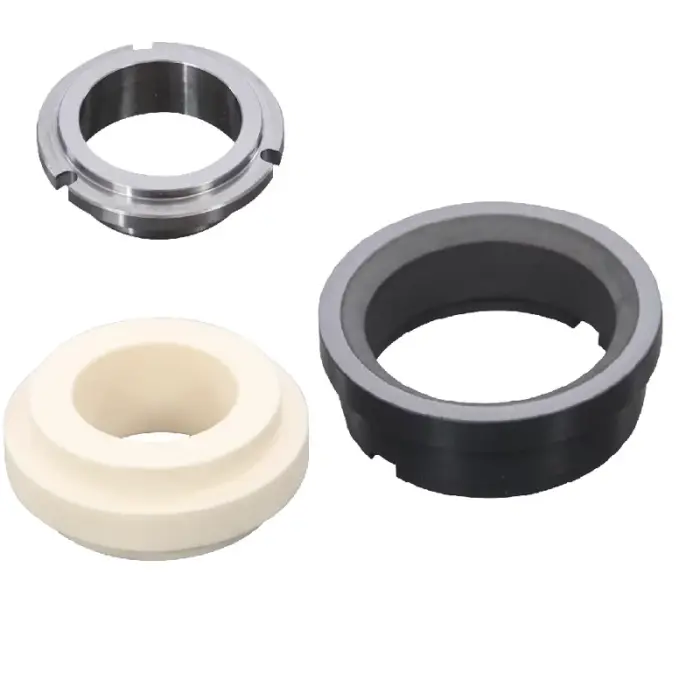
Types & Overview — Quick list with short intros
Monolithic Hard Rings (SiC / Tungsten Carbide)
One-piece hard ceramic or carbide rings offer excellent abrasion resistance and thermal conductivity. Suitable for abrasive or high-temperature services where long face life is required.
Carbon / Graphite Rings
Carbon/graphite rings provide forgiving face compliance, good run-in behaviour and compatibility with many rotating hard faces. Common in general-purpose and vibrating services.
PTFE-Lined / Composite Stationary Seats
PTFE-lined metal seats or full PTFE rings suit aggressive chemistries and sanitary needs. They trade off abrasion resistance for chemical inertness and non-metal wetted surfaces.
Split / Segmental Stationary Rings
Split or segmented rings are designed for large diameters or retrofit where housing removal is impractical. They enable in-situ replacement and reduce downtime in field service.
Cartridge / Adapter Mounted Seats
Pre-mounted stationary seats inside cartridge seals or adapter sleeves simplify installation, ensure concentricity and reduce human error during assembly.
Coated & Engineered Surfaces
Special coatings (e.g., DLC, ceramic coatings) or engineered surface finishes improve wear or reduce friction in demanding services. Use when standard materials underperform.
Search & Long-tail Keywords
Recommended long-tail keywords: stationary seal rings, stationary seal seats, stationary seal ring suppliers, mechanical seal stationary rings pdf.
Selection Guide — How to choose stationary seal rings
- Face pairing: Choose stationary material to complement the rotating face (hard-on-soft or soft-on-hard). Typical pairs: SiC (stationary) vs carbon (rotating) or carbon (stationary) vs SiC (rotating).
- Process conditions: For abrasive slurries and high temperature prefer hard ceramics/TC; for corrosive chemistry choose PTFE-lined or corrosion-resistant metals.
- Static sealing: Check secondary seals (O-rings) compatibility with process media and temperature—these secure the stationary ring and prevent leakage behind the face.
- Dimensional & tolerance requirements: Provide ID/OD, axial thickness, face runout, and gland depth. For split rings specify segment count and locating features.
- Maintenance strategy: Consider cartridge or split seats when downtime is critical; keep face spare sets and replacement seats matched to rotating faces.
Quick tip: When requesting spares include seal part number, pump model, shaft diameter, face material and condition of the shaft sleeve for accurate cross-reference.
Stationary Seal Rings — Comparison Table
Reference comparison for procurement and engineering. Confirm final ratings with manufacturer datasheets.
| Type | Typical Use | Temp Range (°C) | Abrasion Resistance | Chemical Resistance | Key Advantages |
|---|---|---|---|---|---|
| Silicon Carbide (SiC) | Abrasive, high-wear, high-temp services | -50 → +300 | Excellent | Good (depends on alloy/porosity) | High hardness, long face life |
| Alumina / Ceramic | Corrosion-resistant, general-purpose | -50 → +250 | Very Good | Very Good | Good thermal stability, cost-effective |
| Tungsten Carbide (TC) | Severe abrasion and impact | -50 → +350 | Excellent | Good (metal matrix) | Extreme wear resistance, long life |
| Carbon / Graphite | General duty, lubricated faces | -200 → +400 (grade dependent) | Moderate | Good | Conformal face, forgiving under misalignment |
| PTFE-lined / Composite | Highly corrosive or sanitary services | -200 → +200 | Poor to Moderate | Excellent | Non-metal wetted surfaces, chemical inertness |
Standard Formats & Packaging
| Item | Typical Formats | Packaging |
|---|---|---|
| Monolithic rings | Single-piece ID/OD/thickness per seal drawing | Boxed with protective film |
| Split/segmental rings | 2–6 segments with locating dowels | Kit with aligning pins and screws |
| PTFE-lined seats | Metal case with bonded PTFE liner | Boxed, sometimes sterile for sanitary use |
-
 Stationary Seal Rings
Stationary Seal Seats for Mechanical Seals
Datasheets & Installation Guides
Installation, Inspection & Best Practices
- Clean gland & face: ensure mating surfaces and gland are free of burrs, dirt and hydrocarbons before installation.
- Check flatness & runout: measure face flatness and gland concentricity; replace rings if face chips or runout exceeds manufacturer limits.
- Secondary seals: use correct O-ring or gasket material and lubrication to prevent extrusion or chemical attack.
- Torque & seating: seat split rings with recommended torque sequence and ensure locating pins are engaged; do not over-compress PTFE-lined seats.
- Initial run-in: perform controlled start-up to stabilize leakage and allow gentle face mating; monitor temperature and leakage during first hours of operation.
Application Industries & Case Examples
- Chemical & petrochemical — corrosive liquids and solvents
- Pulp & paper — abrasive slurries and solids handling
- Water & wastewater — large-diameter split seats for field service
- Food & beverage — PTFE-lined seats for sanitary service
- Power & utilities — high-temperature boiler feed pumps
Standards & HS Code Guidance
- ISO 21049 — Guidance for shaft sealing systems in pump applications; useful when specifying face pairings and support systems.
- ASTM / EN material standards — Request material numbers and certificates for ceramic, SiC and carbide rings.
- HS code guidance — Stationary seal rings and mechanical seal parts commonly classify under HS 8484.20 (mechanical seals and parts) or under ceramic/metal parts headings depending on manufacturing—confirm with customs/broker for exact subheading.
FAQ — Common Questions for Procurement & Maintenance
- Q: Why does a stationary ring chip or crack?
- A: Common causes include mechanical shock during installation, thermal shock, entrained solids causing edge impacts, or improper handling. Replace and correct root cause (filtration, soft start, or different face material).
- Q: Can I swap material types (e.g., carbon → SiC) without changing rotating face?
- A: You can change stationary material but ensure compatible face pairing. SiC vs carbon is common; verify thermal expansion and run-in behavior and update secondary seals if needed.
- Q: How tight should a split ring be installed?
- A: Install per supplier torque sequence and use locating dowels to set axial position; avoid forcing segments which can induce stresses—follow the supplied installation jig instructions.
- Q: What maintenance spares should be stocked?
- A: Keep matched stationary rings (or cartridges), secondary O-rings, face sets and, for split rings, a full segment kit to minimize downtime on critical equipment.
- Q: How does surface roughness affect face life?
- A: Surface finish of the mating rotating face influences run-in and wear—provide Ra values to supplier and use recommended sleeve finishes (e.g., Ra 0.2–0.6 μm as a typical guideline depending on materials).
More FAQs
Can PTFE-lined seats be reground in the field?
PTFE-lined seats generally cannot be field-reground to precision; replacement or factory rework is recommended to ensure flatness and thickness control.
Are split rings leak-free compared to monolithic rings?
Properly designed and installed split rings can match monolithic performance. Correct segment fit, locating features and installation torque are essential to prevent micro-gaps.
What inspections should be performed during overhaul?
Inspect face condition, chip/crack detection, secondary seal condition, gland surface and sleeve finish. Measure dimensions against the OEM drawing before reassembly.