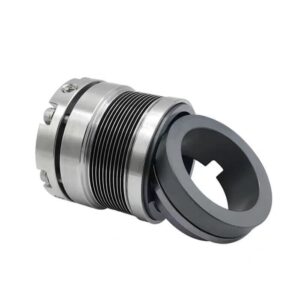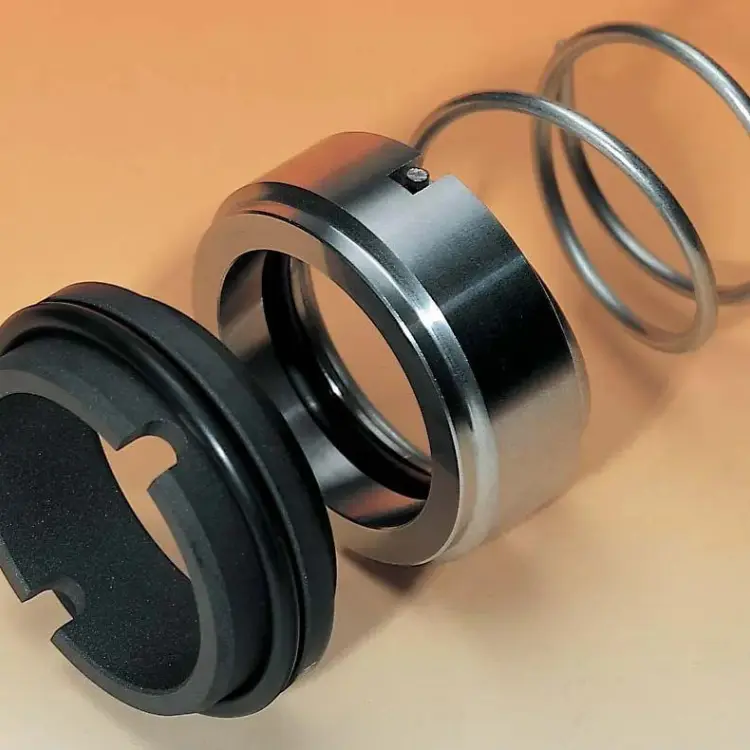
Elastomer Bellows Mechanical Seals for Pumps
Compact, self-contained mechanical seals for centrifugal and rotary pumps. Reliable sealing in water, wastewater, chemical and HVAC services.
-
✅ Eliminates dynamic O-rings — fewer leak paths
-
✅ NBR, EPDM, FKM, HNBR elastomer options
-
✅ Cartridge & component styles for fast retrofit
ISO 9001 | Material Traceability | CAD & PDF Datasheets
Product Description
Elastomer (rubber) bellows seals combine a molded elastomer bellows and a single-spring or multi-spring drive to provide a compact, self-contained mechanical seal for centrifugal and rotary pumps. The flexible bellows replaces O-rings and eliminates dynamic secondary seals near the shaft, improving reliability in abrasive or particulate-laden fluids and in applications with small shaft deflections.
The design is widely used across water, wastewater, chemical, HVAC and light petrochemical pump services.
Common Aliases: Rubber bellows seal, Elastomeric bellows seal, Elastomer bellows mechanical seal, Rotary bellows seal, Rubber expansion bellows seal.
Key Buyer Features
-
Integrated rubber bellows eliminates dynamic O-rings and simplifies maintenance.
-
Single-spring cartridge or component options for fast retrofit.
-
Proven compatibility with common elastomers (NBR, EPDM, FKM, HNBR, silicone) to match chemical resistance needs.
-
Compact footprint for limited-stuffing-box installations; tolerates minor shaft misalignment.
-
Cost-effective for low-to-moderate pressure pump services.
Materials & Seal Face Options
Typical seal face pairings:
-
Carbon vs Ceramic
-
SiC (silicon carbide) vs SiC
-
Tungsten Carbide vs SiC
Bellows / Secondary elastomer options:
NBR (Buna-N), EPDM, FKM (Viton), HNBR, Silicone — selected to match fluid compatibility and temperature.
Metal parts:
304 / 316 stainless steel common; duplex or higher alloys available for aggressive chemistry.
Typical Operating Ranges
| Parameter | Typical Value / Range |
|---|---|
| Shaft diameter (stock range) | 18 mm – 110 mm (common sizes: 18, 20, 22, 25, 28, 32, 40, 50, 65, 80, 100, 110 mm) |
| Product pressure (max, typical) | Up to ≈ 20 bar (290 psi) depending on face pairing and bellows construction |
| Temperature range (elastomer dependent) | −40 °C to +205 °C (elastomer type dictates upper limit) |
| Shaft surface speed | Up to ~15 m/s (≈ 3000 ft/min) depending on face material and cooling |
| Configurations | Component or cartridge; rotary or stationary bellows variants available |
Note: Final selection must be confirmed with pump data and process conditions.
Technical Specifications
| Item | Typical Value / Range |
|---|---|
| Seal Type | Elastomer (rubber) bellows mechanical seal |
| Shaft diameters (stock) | 18, 20, 22, 25, 28, 32, 40, 50, 65, 80, 100, 110 mm |
| Max recommended pressure | Up to ~20 bar (typical) |
| Temperature (elastomer dependent) | −40 °C to +205 °C (typical) |
| Face materials | Carbon, Ceramic, SiC, Tungsten Carbide |
| Secondary seals | NBR, EPDM, FKM, HNBR, Silicone |
| Speed limit | Up to ~15 m/s (check specific model) |
| Configurations | Component or cartridge; rotary or stationary bellows variants available |
Common Sizes & Ordering Example Codes
Example ordering codes:
-
EB-25-C-SiC-FKM — Elastomer bellows, 25 mm shaft, Carbon/SiC faces, FKM secondary.
-
RB-50-SiC-NBR — Rubber bellows, 50 mm shaft, SiC faces, NBR secondary.
When requesting a quote, please include:
-
Pump make/model
-
Shaft diameter
-
Operating temperature and pressure
-
Process fluid
-
Desired materials
Application Scenarios
-
Water treatment and wastewater pumps (sand/sludge tolerant solutions).
-
Chemical dosing and process pumps handling corrosive aqueous chemistries.
-
HVAC chilled-water and condenser circulation pumps.
-
General industrial pumps where cartridge retrofits reduce maintenance downtime.
Comparison: Elastomer Bellows vs Metal Bellows vs Pusher Seals
| Characteristic | Elastomer Bellows | Metal Bellows | Pusher (O-ring) Seals |
|---|---|---|---|
| Best for | Water, chemicals, light hydrocarbons; particulate tolerance | High temperature, high pressure, aggressive chemistries | General duty where dynamic O-ring acceptable |
| Max temp | ~205 °C (elastomer limited) | Much higher (metal bellows) | Elastomer limited |
| Abrasion tolerance | Moderate — face selection important | Good with hard faces | Lower (O-rings exposed) |
| Cost | Moderate / economical | Higher (welded bellows) | Lowest initial cost |
| Retrofits | Cartridge/component widely available | Retrofit possible but costlier | Simple but less robust |
Frequently Asked Questions
Q1: Can you supply cartridge rubber bellows seals for retrofit to standard pump models?
A: Yes. We supply both cartridge and component elastomer bellows seals designed to fit common pump frames. Provide pump model, shaft diameter and operating conditions for a rapid quotation.
Q2: Which elastomer should I choose for my pump fluid?
A: Choice depends on chemistry and temperature. NBR is typical for hydrocarbons, FKM (Viton) for higher temperature and chemical resistance, EPDM for polar fluids and steam resistance. Provide fluid name and temperature range for exact selection.
Q3: Are rubber bellows seals suitable for solids-bearing fluids?
A: Yes for moderate solids loads; pair with hard face materials (SiC/TC) and a flush plan if solids are fine abrasive. For heavy slurries consider specialized designs.
Q4: What is the expected lead time and MOQ for standard sizes?
A: Standard stock sizes are typically available for small MOQs and short lead times. Custom elastomer blends or nonstandard dimensions require engineering review and longer lead times.
Q5: Do you provide CAD or PDF datasheets and certified material traceability?
A: Yes. CAD, PDF datasheets and material certificates are provided on request with quotation.
How to Order / Quote Checklist
Please include when requesting a quote:
-
Pump make & model (or OEM drawing).
-
Shaft diameter and shaft sleeve details.
-
Process fluid name, specific gravity, viscosity and solids content (if any).
-
Operating temperature range and pressure.
-
Desired seal materials (if known) and any regulatory or certification requirements.
-
Required delivery schedule and purchase quantity.
Product Catalog & Datasheet
-
Download: Elastomer bellows / Rubber bellows seal Technical Data Sheet (PDF)
- Download: Elastomer bellows / Rubber bellows seal Specifications (PDF)
Request a Quote
Contact our sales team with your pump model, shaft diameter, process fluid, and operating conditions. We will provide pricing, lead time, and available documentation.