
Overview
What are Stationary Seal Seats (mating rings)?
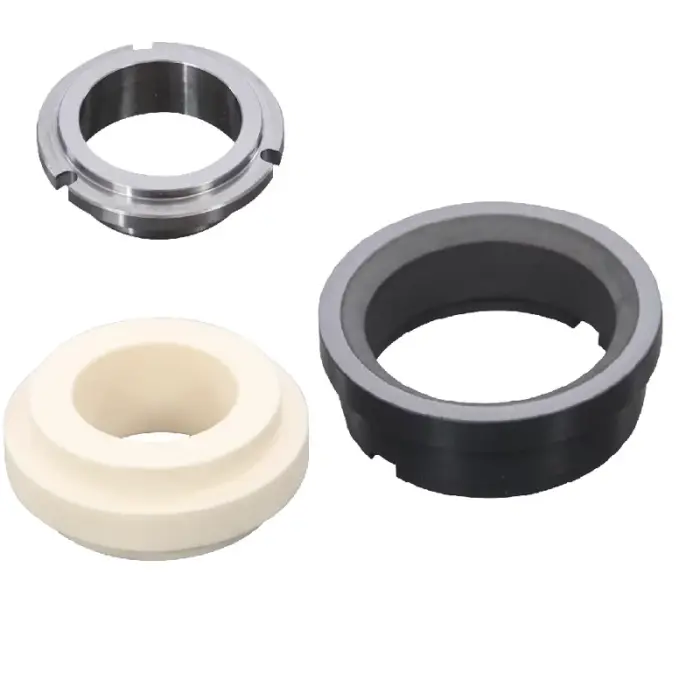
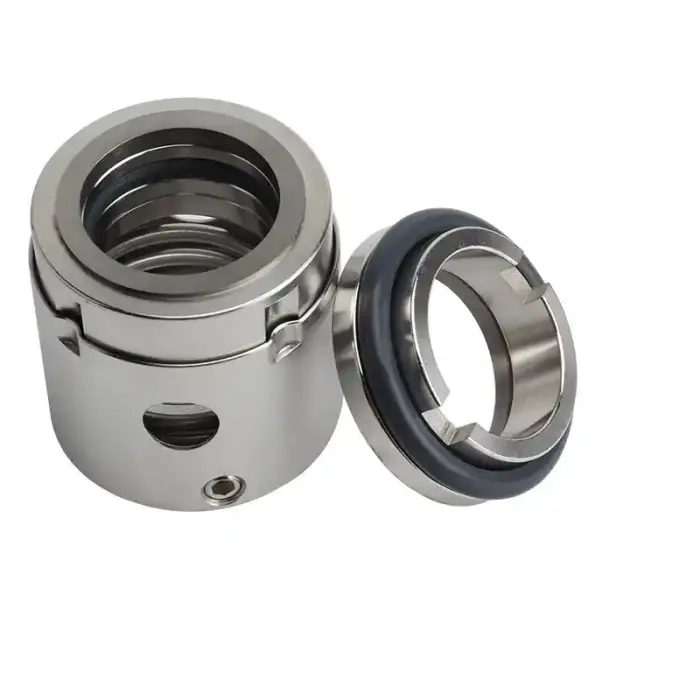
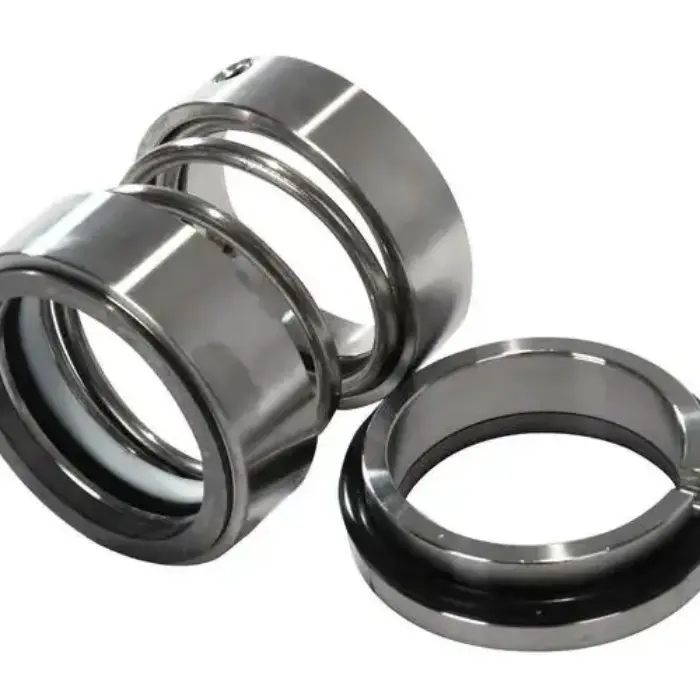
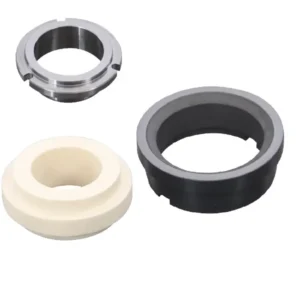
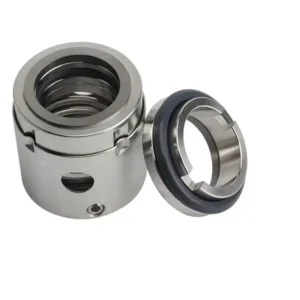
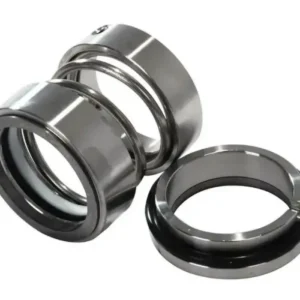
Stationary seal seats for mechanical seals — also called stationary rings, mating rings or seal seats — are the non-rotating face in an end-face mechanical seal assembly. The stationary seat is mounted in the pump gland, housing or a dedicated seat holder and provides the fixed face against which the rotating face runs to form the primary seal.
Product Variants & Styles
Common styles
-
O-ring mount stationary seats (O-ring seat) — universal retrofit style for many pump OEMs (quick replacement).
-
Cup seat / insert (flange / cup style) — installed into a recess; often used for higher axial location stability.
-
Split / cartridge compatible seats — for large-bore or hard-to-service equipment.
Materials & Selection Guidance
Common face materials
-
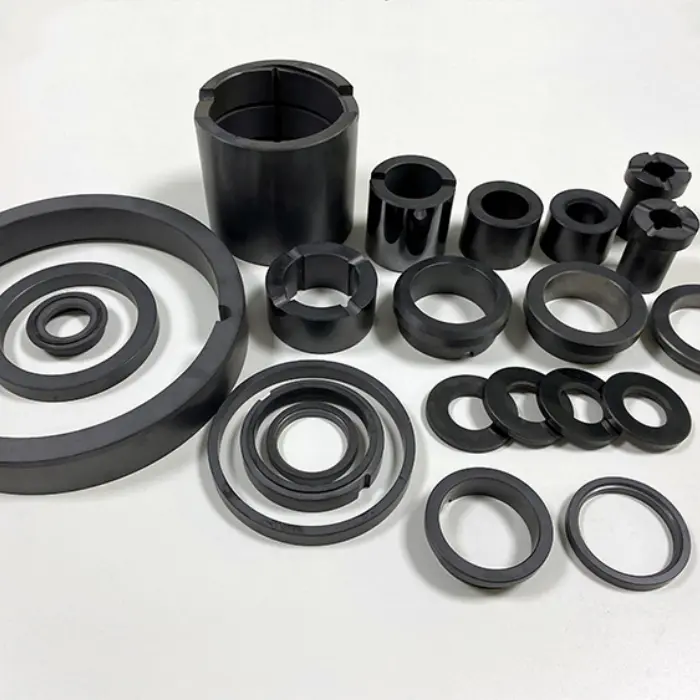
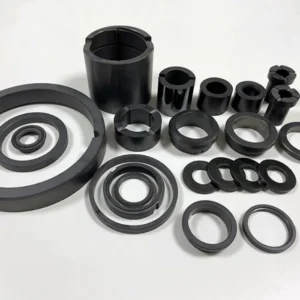
Silicon carbide (SiC) — high hardness and wear resistance; excellent for abrasive, high-speed and corrosive services.
-
Tungsten carbide (WC) — extremely hard, ideal where abrasive wear is severe; often paired against carbon rotating faces.
-
Carbon-graphite — self-lubricating, forgiving at start/stop and compatible with many mating faces; preferred where run-dry or low friction is needed.
-
Alumina / ceramic grades — cost-effective hard faces for many non-abrasive services.
Selection note: material choice is driven by pressure, temperature, speed (surface PV), fluid chemistry and suspended solids — provide operating temperature, pressure, shaft speed (RPM) and fluid details for exact recommendation.
Key Performance & Service Limits
-
Typical shaft diameter coverage: common component ranges for repair and OEM are available from small bores (~10–12 mm) up to large bores (100–200+ mm); consult OEM drawing for precise OD and operating height.
-
O-ring mount seat pressure guidance: many O-ring mount seats are commonly offered and rated for typical pump pressures up to ~400 psi (≈27.6 bar) depending on elastomer and seat design — confirm for high-pressure applications.
-
Material temperature guidance (typical service ranges): carbon-graphite grades are commonly used to ~250–538 °C depending on grade; SiC and advanced ceramics are used at much higher temperatures in certain constructions, but practical mechanical-seal service ranges more often fall under 400–525 °C depending on chemistry and bonding. Always confirm with material certificate and application details.
Technical Specification
The table below shows typical, commonly stocked sizes and service guidance for fast procurement and OEM replacement. For exact mating face OD, operating height and OEM fit-up, supply the original part number, pump model or a drawing.
| Style | Material | Shaft ID (mm) | Typical OD (mm) | Thickness / Height (mm) | Typical Max Service Temp (°C) | Typical Max Pressure (bar) | Secondary Seal (typical) |
|---|---|---|---|---|---|---|---|
| O-ring mount seat | Silicon Carbide (SiC) | 12 | 40 | 6 | ≤400 | ≤27.6 (400 psi) | Buna / Viton / EPDM |
| O-ring mount seat | Tungsten Carbide (WC) | 25 | 62 | 8 | ≤500 | ≤27.6 (400 psi) | Buna / Viton |
| Cup seat / insert | Carbon-Graphite | 40 | 80 | 10 | ≤538 | Varies — contact | Elastomer / PTFE |
| O-ring mount seat | Alumina Ceramic | 50 | 95 | 10 | ≤525 | ≤27.6 (400 psi) | Viton / FFKM |
| Cup seat / OEM | Silicon Carbide (SiC) | 65 | 110 | 12 | ≤400 | Varies — contact | Viton / EPDM |
| O-ring mount seat | Silicon Carbide (SiC) | 80 | 130 | 12 | ≤400 | ≤27.6 (400 psi) | Viton / FFKM |
| Cup seat / flange insert | Tungsten Carbide (WC) | 100 | 160 | 15 | ≤500 | Varies — contact | Viton / FFKM |
| O-ring mount seat | Carbon-Graphite | 125 | 190 | 16 | ≤538 | ≤27.6 (400 psi) | PTFE / FFKM |
| Cup seat / OEM | Silicon Carbide (SiC) | 150 | 220 | 18 | ≤400 | Varies — contact | Viton / FFKM |
(Table is representative of commonly stocked sizes — final selection requires OD, operating height and OEM style.)
Applications
Typical industries & equipment
-
Centrifugal pumps (process water, chemical pumps, slurry pumps — using cup or O-ring seat variants).
-
Mixers, agitators, and high-speed rotating equipment.
-
Compressors, vacuum pumps and some specialty turbine seals (with appropriate geometry).
-
OEM replacement / MRO spare parts for pump rebuilders and aftermarket suppliers.
Installation, Inspection & Maintenance
Quick procurement & fit-up checklist
-
Provide shaft diameter (ID), seat OD, operating height / thickness, and the OEM part number or pump model.
-
Confirm seat style (O-ring mount / cup / insert) and secondary seal elastomer (Buna, Viton(Viton®), EPDM, FFKM).
-
Specify fluid chemistry, max temperature, max pressure and shaft speed (RPM).
-
Request a drawing or confirm with a sample for large or critical seals.
-
Ask for material certificates (MTC) and aftermarket inspection report on delivery.
Field inspection tips: check face finish, no chips on mating edges, verify concentricity and operating height tolerance before commissioning.
Advantages
-
Fast OEM match & direct replacements — stocked common O-ring and cup styles for rapid MRO turnaround.
-
Material breadth — SiC, WC, carbon and ceramic options to match abrasives, temperatures and chemicals.
-
Custom machining — precision OD/ID/height to meet OEM operating height tolerances and runout requirements.
-
Quality traceability — material certificates and inspection reports available on request.
-
Technical support — engineering guidance on material pairing (rotating vs stationary faces) to extend seal life.
Material Comparison
| Property / Material | Carbon-Graphite | Silicon Carbide (SiC) | Tungsten Carbide (WC) | Ceramic (Alumina) |
|---|---|---|---|---|
| Typical Advantage | Self-lubricating; forgiving | High wear & corrosion resistance; excellent thermal shock | Extremely wear resistant; best for abrasive services | Cost-effective hard face; good corrosion resistance |
| Common Use Cases | Start/stop, low friction, pump repair | Abrasive slurries, chemical services, high speed | Abrasive, high-abrasion slurry services | General hard-face replacement where SiC cost is not justified |
| Typical Temp Guidance | up to ~250–538 °C (grade dependent). | Practical mechanical-seal service commonly up to ~400–525 °C (grade & bonding dependent). | Often used to ~500 °C in applications — brittle vs thermal shock. | Typical limits similar to ceramic grades — confirm grade. |
FAQ
Q1: What information do you need to quote a stationary seat?
A: Shaft ID, seat OD, operating height/thickness, seat style (O-ring or cup), material preference (or service conditions), pump model / OEM part number and fluid/pressure/temperature details.
Q2: Do you supply OEM interchange and reverse-engineer from sample?
A: Yes — we offer OEM interchange sizing and can reverse-engineer from a sample or drawing to provide exact mating ring replacements.
Q3: What are typical lead times and MOQs?
A: Lead time depends on material and finish. Stocked SiC and carbon sizes can ship quickly; custom machined or special alloy seats require longer lead time. MOQ and lead time vary by material and batch — request quote for firm lead time.
Q4: Are material certificates and inspection reports available?
A: Yes — material test certificates (MTC) and inspection reports can be provided upon order.
Q5: Can you supply seals for high-pressure or high-temperature services?
A: Yes — depending on seat style and material pairing. Many O-ring seat designs are commonly used up to ~400 psi (27.6 bar); contact our engineering team for high-pressure metal-faced solutions and custom designs.
Q6: Do you provide installation support or installation drawings?
A: We provide dimensioned drawings and engineering guidance; field installation support can be arranged as required.
E-E-T-A
-
Experience: We supply stationary mating rings to pump OEMs and aftermarket repair houses and understand common retrofit dimensions and pump operating parameters. (Note: for best fit, provide OEM model/part or sample.)
-
Expertise: Material pairing guidance (e.g., SiC vs carbon) follows proven face-pairing principles used widely in the mechanical-seal industry.
-
Authoritativeness: Product choices and service guidance are aligned with established mechanical-seal design practice and typical pump OEM replacement approaches.
-
Trustworthiness: Material certificates (MTC), batch traceability and inspection reports are available; we recommend proof-of-material (MTC) for critical services.
-
Accountability: Every supplied item is inspected and matched to the provided drawing/part number; non-conforming parts are handled per purchase agreement.
Product Catalog & Technical Download
Final — Purchase / Order Flow
-
Send part number / pump model / sample + operating conditions.
-
We confirm interchange / quote and lead time.
-
Issue PO → receive MTC & inspection plan → shipment.
-
After-sales support: installation guidance and replacement recommendation.
Company Contact
Company: AoHong Group — Hengshui Aohong (Seals & Engineered Components)
Sales & Technical Inquiry:
-
-
Email: sales@aohongglobal.com (for datasheet requests and fast quotes)
-
Phone: +(86) 153 7318 1024 (please replace with your official number)
-