
1. Why the Oil & Gas Industry Needs Custom Quartz Glass Parts
Sight glasses, level gauge windows, and inspection components in oil and gas facilities operate under constant exposure to high temperatures, high pressures, and aggressive process media. Standard glass products often cannot survive these conditions for long.
Real-world example:
A refinery installed a standard borosilicate sight glass on a fractionator. Within three months, hairline cracks appeared. During a routine walkdown, the glass burst without warning, forcing an emergency shutdown. The replacement failed the same way.
Root cause analysis showed that normal operating temperature at that location was around 350 °C, but during steam purging it dropped rapidly to 150 °C. The thermal stress from rapid temperature cycling far exceeded what standard borosilicate glass could handle. After switching to a custom quartz glass sight glass, the unit operated for over 18 months without cracking or loss of visibility.
Common field problems reported by operators and maintenance teams:
Sight glass failure disrupts normal operation and causes unplanned downtime.
Cracks develop after thermal cycling, leading to frequent replacement.
Transparency degrades in corrosive environments, reducing visibility.
Standard glass dimensions do not fit non-standard equipment ports.
These issues are often treated as “glass failures,” but the real causes are usually material selection, application mismatch, or part design. Standard glass works for basic viewing tasks, but high heat, thermal shock, and aggressive media quickly push it beyond its limits. In demanding oil and gas environments, a standard sight glass is rarely enough. Operators need a quartz glass solution engineered for their exact operating conditions.
2. Why Glass Components Fail in Oil & Gas Equipment
2.1 Thermal shock from high temperatures and cycling
Refinery units such as fractionators, reactors, and fired heaters, as well as gas processing and petrochemical plants, subject components to sustained high temperatures. During start-up, shutdown, or process swings, temperatures rise or drop rapidly, creating thermal stress across the part. If the glass does not have sufficient thermal stability, the result is micro-cracks, edge chipping, or sudden fracture.
Quick material comparison:
| Material | Continuous Use Limit | Thermal Expansion Coefficient |
| Standard tempered glass | ~180 °C | High |
| Borosilicate glass | ~280 °C | Moderate |
| Quartz glass | 1100–1250 °C | ~5×10⁻⁷ K⁻¹ (about 1/20 of ordinary glass) |
Quartz glass can withstand temperature differentials over 1000 °C, making it far more suitable for thermal cycling applications.
2.2 Material degradation from corrosive media
Hydrocarbons in oil and gas processes often carry H₂S, CO₂, organic acids, and other corrosive compounds. Some process stages also introduce amine solutions, inhibitors, or chemical treatment agents. Over time, ordinary glass surfaces undergo silicate network breakdown—etching, loss of clarity, and reduced mechanical strength.
Quartz glass, with SiO₂ content ≥99.96%, offers exceptional chemical durability. Except for hydrofluoric acid and hot phosphoric acid, it resists virtually all media encountered in refinery and gas processing operations.
2.3 Standard sizes that don’t fit
Different assets have different installation envelopes, pressure ratings, sealing methods, and viewing positions. Off-the-shelf glass often cannot match non-standard flange interfaces, custom thickness requirements, or irregular shapes. That mismatch drives the need for custom quartz glass fabrication.

3. Why Quartz Glass Is the Preferred Material
3.1 Handles high-temperature service
Quartz glass is ideal for high-temperature viewports, furnace inspection systems, thermal processing equipment, and high-temperature analyzers. Key properties:
Softening point: 1730 °C
Continuous use range: 1100–1250 °C
Extremely low thermal expansion coefficient
This significantly reduces the risk of failure caused by temperature cycling.
3.2 Stands up to corrosive environments
Excellent chemical stability makes quartz glass suitable for petroleum processing units, chemical plants, and corrosive-media observation systems. It reduces replacement frequency caused by material incompatibility, lowering long-term maintenance costs.
3.3 Delivers real-time visibility
Operators need to see internal liquid levels, flow patterns, and equipment status clearly. Quartz glass provides broad-spectrum high transmission from UV to IR, giving crisp visibility for visual inspection, optical detection, and analytical instruments.
4. Typical Quartz Glass Applications in Oil & Gas
The table below provides a quick reference to common quartz glass products used in the oil and gas industry.
| Product | Typical Equipment / Application | Key Performance |
| Quartz Circular Sight Glass | Reactors, columns, pressure vessels, fired heater viewports | Temp ≤1000 °C, pressure ≤10.0 MPa |
| Quartz Tube Sight Glass / Inline Sight Glass | Oil & gas pipeline flow monitoring | Temp ≤1000 °C, pressure ≤10.0 MPa |
| Quartz Level Gauge Glass | Storage tanks, pressure vessels, boiler drum level monitoring | SiO₂ ≥99.99%, bi-color display |
| Quartz Glass Plate / Sheet | Heater/incinerator windows, optical inspection ports | Temp ≤1000 °C, broad-spectrum transmission |
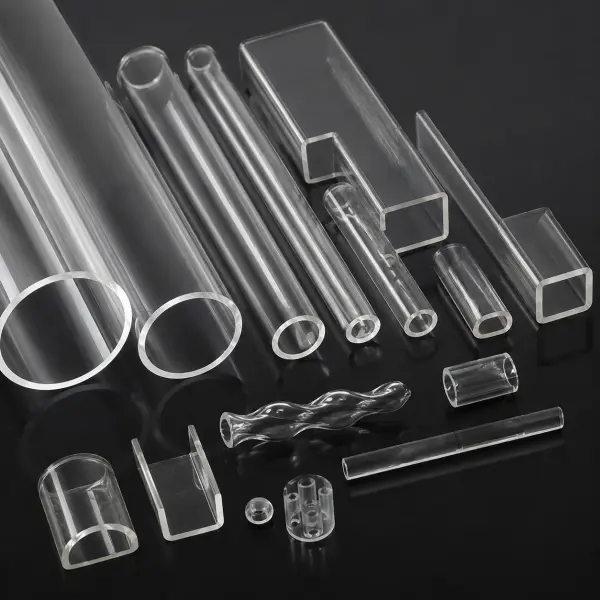
| Quartz Glass Tube (Round) | UV fluorescence sulfur analyzers, chromatographs, high-temp lines | SiO₂ ≥99.96%, tight dimensional control |
| Quartz Capillary Tube | Crude oil thermal stability testing, capillary GC | Micron-scale ID, chemically inert |
| Custom-Shaped Quartz Tube (U, Rectangular, Spiral) | Specialty flow reactor systems, gas detection instruments | Made to drawing |
| UV Quartz Sleeve | Exhaust gas/wastewater UV treatment systems | UV transmittance ≥90% |
| Quartz Crucible | Ash determination, trace element analysis labs | Refractoriness ≥1580 °C, high purity |
| Custom Quartz Parts | Non-standard equipment, special structural locations | Made to drawing, dimensional accuracy controlled |
Note: Temperature and pressure ratings are typical values. Final specifications depend on part design, diameter, thickness, gasket type, and flange rating. Always confirm with our engineering team based on your actual operating conditions.
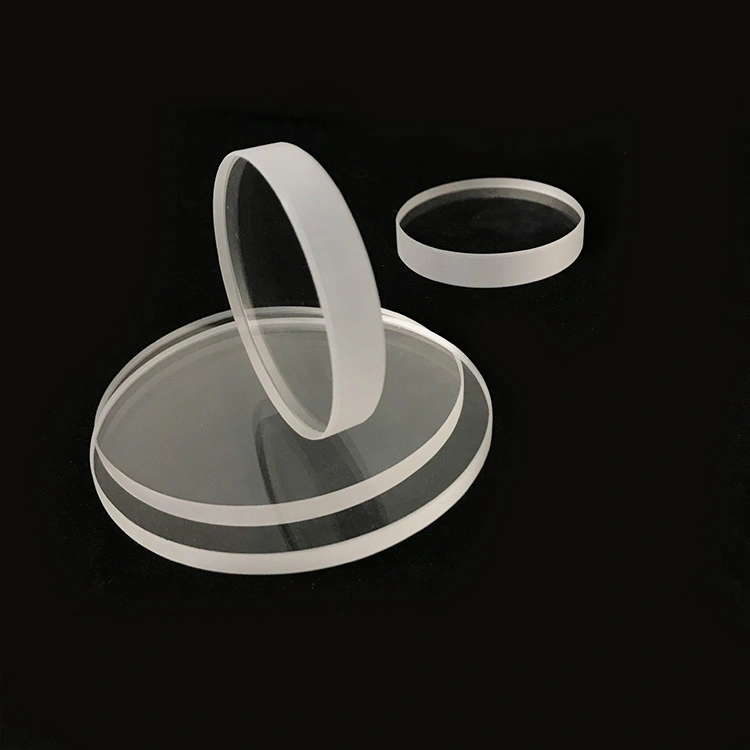
4.1 Quartz Circular Sight Glass (Equipment Sight Glass / Viewport)
Suited for:
Refinery fractionators, reactors, hydroprocessing units, petrochemical pressure vessels, high-temperature incinerators, and gas processing columns.
Mounting location:
Side-wall or top-mounted viewing ports on the vessel shell, used to observe material state, vapor/liquid interfaces, flame, or catalyst fluidization.
Matching conditions:
Operating temperature 280–1000 °C, pressure 0.6–10.0 MPa, service with thermal cycling.
Selection notes:
Determine diameter and thickness based on the flange connection. Use PTFE or asbestos-free fiber gaskets below 280 °C; switch to graphite gaskets above 500 °C. Housing material options include carbon steel, 304 SS, or 316 SS.
[Learn more about our Quartz Circular Sight Glasses →]
4.2 Quartz Tube Sight Glass (Inline Sight Glass / Straight-Through Sight Glass)
Suited for:
Petrochemical piping systems, natural gas transmission lines, refinery feed/discharge lines, and chemical transfer piping.
Mounting location:
Straight pipe runs (horizontal or vertical) at pump discharge, heat exchanger inlet/outlet, or anywhere media flow needs visual verification.
Matching conditions:
Media temperature ≤1000 °C, pressure ≤10.0 MPa. Media can be liquid, gas, or steam. Used to verify flow condition and detect liquid carryover or gas entrainment.
Selection notes:
Choose standard type for clean fluids. For media that tends to crystallize or clog, select a version with flushing ports. Connection options: flanged or tri-clamp.
[See Quartz Tube Sight Glass options →]
4.3 Quartz Level Gauge Glass
Suited for:
Oil storage tanks, chemical feedstock tanks, pressure vessels, reactors, boiler drums, LPG/ammonia storage vessels.
Mounting location:
Side-mounted (vertical) or top-mounted on the vessel, connected via flange or threaded coupling to form a communicating column.
Matching conditions:
Service media include gasoline, LPG, ammonia, propane, propylene, aromatics, acids, and water. Suitable for high-temperature, high-pressure, viscous fluid, or long-distance/night-time level reading applications.
Selection notes:
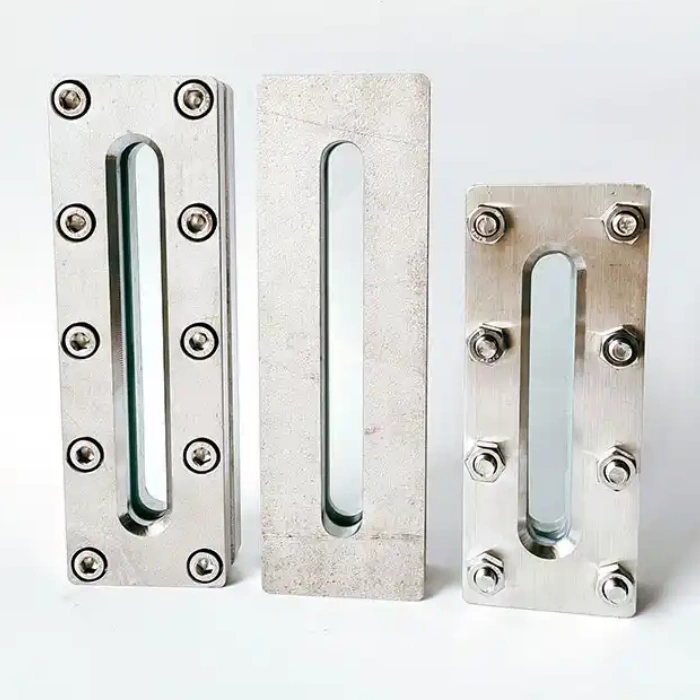
Reflex level gauge glass features prismatic grooves on the back side. The liquid-filled zone absorbs light and appears dark, while the vapor space reflects light and appears bright, creating sharp level contrast. Ideal for colorless, transparent liquids or when higher contrast is required.
Transparent level gauge glass has smooth surfaces. Combined with red/green filter films, it produces a bi-color effect: vapor space appears red, liquid space appears green. Best for colored, opaque, or dark liquids.
[Explore Quartz Level Gauge Glass products →]
4.4 Quartz Glass Plate / Sheet (High-Temperature Window, Optical Window)
Suited for:
Fired heater and incinerator viewports, high-temperature reactor windows, infrared thermography inspection windows, and optical instrument protection windows.
Mounting location:
Openings in furnace walls, rectangular/square viewing ports on equipment housings, and light-path entry points on detection instruments.
Matching conditions:
Continuous high-temperature environment at 800–1000 °C, scenarios requiring broad-spectrum light transmission (UV to IR), and precision measurement setups needing optical-grade flatness.
Selection notes:
Plate dimensions and thickness are determined by the window opening. For optical instrumentation, specify optical-grade quartz windows.
4.5 Quartz Glass Tube (Clear Fused Quartz Tube)
Suited for:
UV fluorescence sulfur analyzers (total sulfur in oil), gas chromatographs, spectrometers, high-temperature lab setups, and corrosive gas/liquid transfer lines.
Mounting location:
Sample cells/detection cells in analytical instruments, high-temperature reaction tubes in laboratories, and high-temperature corrosive media piping.
Matching conditions:
Analytical work requiring high purity (SiO₂ ≥99.96%), high-temperature corrosive environments, and detection light paths demanding high transmission.
Selection notes:
Confirm outer diameter, inner diameter, and length based on instrument interfaces. Verify purity grade for analytical applications. Confirm temperature and pressure ratings for piping applications.
4.6 Quartz Capillary Tube
Suited for:
Crude oil thermal stability testing apparatus, capillary GC, and micro-sample analytical instruments.
Mounting location:
Chromatographic columns, sample loading tubes, and microfluidic channels.
Matching conditions:
Milligram-scale crude oil samples for thermal stability testing, gas chromatography requiring high separation efficiency, and microchannels demanding chemically inert inner surfaces.
Selection notes:
Critical parameters are inner diameter accuracy and roundness. Customize length and end finishing per instrument requirements.
4.7 Custom-Shaped Quartz Tubes (U-Shaped, Rectangular, Spiral)
Suited for:
High-temperature reaction systems with special flow paths, gas detection instruments, and custom laboratory setups.
Mounting location:
Piping connections requiring flow direction changes, routing in confined installation spaces, and piping where additional heat exchange area is needed.
Matching conditions:
High-temperature corrosive media transfer, tight-space piping layouts, and specific fluid-path requirements.
Selection notes:
Provide accurate drawings or samples. Define operating temperature, media, and pressure. Confirm parameters such as bend radius and rectangular cross-section aspect ratio.
4.8 UV Quartz Sleeve
Suited for:
UV disinfection / photochemical reaction units in oily wastewater treatment, exhaust gas treatment, and environmental protection systems within oil and gas facilities.
Mounting location:
Positioned around UV lamps as a protective and light-transmitting barrier, installed in the fluid channel so UV light passes through the sleeve and irradiates the medium.
Matching conditions:
Treatment stages using UV light for sterilization or photochemical reactions.
Selection notes:
UV transmittance ≥90%. Dimensions must match UV lamp specifications. Verify operating temperature and pressure.
4.9 Quartz Crucible
Suited for:
Oil quality testing and R&D laboratories.
Common uses:
Ash determination: High-temperature ashing of crude oil, fuel oil, and lubricating oil per GB/T 508 and equivalent standards to determine ash content.
Trace element analysis: Determination of Fe, Na, Ni, V, Ca, and other trace metals in crude oil.
Matching conditions:
High-temperature heating (typically 550–800 °C ashing). Requires chemically inert vessels that won’t react with samples at elevated temperatures.
Selection notes:
Choose specifications per test standards (e.g., GB/T 508). For trace analysis, use high-purity quartz crucibles to eliminate contamination from the vessel itself.
4.10 Custom Quartz Glass Parts
Suited for:
Equipment viewports with non-standard flange interfaces, observation assemblies in unique installation spaces, and irregular quartz parts with holes, steps, or threads.
Matching conditions:
Locations where standard products cannot fit or mount, constrained installation envelopes, and parts that must combine multiple functions into a single component.
Selection notes:
Supply complete drawings or samples with dimensional tolerances and surface quality requirements. Define operating temperature, pressure, and media. Confirm that available fabrication processes meet accuracy needs.
5. Key Factors When Selecting Quartz Glass Components
5.1 Operating temperature
Pinpoint long-term operating temperature, transient temperature swings, and whether thermal cycling occurs. For service above 300 °C, prioritize quartz glass over borosilicate or tempered glass.
5.2 Media environment
Identify corrosive agents—H₂S, acid gases, chemical solvents—and assess whether higher chemical stability is required. Quartz glass is suitable for nearly all oil and gas process media except hydrofluoric acid and hot phosphoric acid.
5.3 Configuration and mounting
Match part dimensions, thickness design, sealing type (commonly PTFE or graphite seals), and mounting style. Structural mismatches are a direct cause of premature glass failure.
6. Why a Custom Quartz Glass Solution Makes Sense
No two industrial applications are exactly alike. Installation space, operating environment, and performance requirements vary from plant to plant.
Take sight glasses as an example: one user needs a circular sight glass for a pressure vessel viewport, another needs a long rectangular window for a level trough, and a third needs a flanged assembly for a piping connection. Off-the-shelf products won’t cover all these scenarios.
A reliable quartz glass supply goes beyond raw material. It includes:
Material selection support for quartz glass grades
Precision fabrication: drilling, contour cutting, edge grinding, chamfering
Custom builds to drawings or samples
Dimensional and quality inspection
Industrial application guidance
7. Frequently Asked Questions
Q1: What is the maximum operating temperature for quartz glass sight glasses?
A: Quartz glass can be used continuously at temperatures from 1100 °C to 1250 °C, with a softening point around 1730 °C. Actual temperature limits depend on part design, thickness, and mounting configuration.
Q2: Can quartz glass be used with H₂S or CO₂ in oil and gas processes?
A: Yes. Quartz glass has excellent chemical resistance to H₂S, CO₂, organic acids, and most process media. It is only attacked by hydrofluoric acid and hot phosphoric acid.
Q3: What is the difference between borosilicate and quartz sight glass?
A: Borosilicate glass is typically limited to about 280 °C, while quartz glass can handle continuous temperatures above 1000 °C. Quartz also has a much lower thermal expansion coefficient, making it far more resistant to thermal shock and rapid temperature cycling.
Q4: Do you provide custom quartz glass dimensions for oil and gas equipment?
A: Yes. We manufacture quartz glass parts to your drawings or samples, including non-standard flange sizes, custom thicknesses, irregular shapes, holes, steps, and threads.
Q5: What sealing materials should be used with quartz glass at high temperatures?
A: Below 280 °C, PTFE or asbestos-free fiber gaskets are common. Above 500 °C, graphite gaskets are recommended. Our engineers can help specify the correct gasket for your operating conditions.
8. Conclusion
In the oil and gas industry, a reliable glass component affects more than visibility—it directly impacts long-term operational safety and uptime.
Choosing quartz glass isn’t simply about picking a material. It’s about matching the exact combination of temperature, pressure, media, and mechanical interface that your equipment demands.
With the right material selection, precision fabrication, and quality control, custom quartz glass parts help industrial assets run more reliably—and longer.
Need a Custom Quartz Glass Solution for Your Oil & Gas Application?
Contact our engineers with your operating parameters, drawings, or samples. We will recommend the right quartz glass product and provide a quotation.
