
A plant manager once told us: “I budget for walkway replacement like it’s a monthly utility bill.” He was only half joking.
Above aeration basins, clarifiers, and flocculation tanks, steel grating simply cannot survive. Hydrogen sulfide, ammonia, chlorine, acidic mists, and constant humidity eat through galvanized coatings in just a few years. Hot-dip galvanized steel starts showing red rust within three years; carbon steel often fails in one or two. The result? A cycle of expensive shutdowns, emergency repairs, and safety hazards that never ends.
We believe walkways should be a long-term asset, not a recurring expense. That’s why we supply molded FRP grating engineered specifically for the corrosive heart of wastewater treatment plants.
The Hidden Weaknesses of Metal Walkways
It’s easy to blame the environment. But the real problem is that metal walkways have three design flaws that no coating can fix.
Flaw 1: Surface Protection Wears Off Where You Walk Most
Walkway corners, nosing edges, and mesh openings see the highest foot traffic. Shoes act like sandpaper, wearing through paint or galvanizing in months. Once bare steel meets moisture and corrosive gases, pitting begins almost immediately and spreads fast.
Flaw 2: Corrosion Starts Where Nobody Looks
The intersection of flat bars, the underside of bearing ends where grating sits on beams — these are dead zones where sludge, moisture, and bacteria collect. They stay permanently wet. Galvanized grating often looks acceptable from above while internal weld points have already corroded through. When someone steps on a weakened section, the result can be catastrophic.
Flaw 3: Microbes Make It Worse
Wastewater microorganisms don’t just live in the tanks; they form biofilms on metal surfaces. Their metabolic byproducts create localized strong-acid micro-environments that accelerate corrosion beyond what moisture alone can cause. This “microbial corrosion” can defeat conventional anti-corrosion coatings in months.
These flaws explain why plants spend 8–10% of the walkway’s initial cost every year on maintenance, and still face full replacement every 3 to 5 years. The solution is not a better coating. It’s a fundamentally different material.
Molded FRP Grating: Corrosion Resistance Built Into the Material
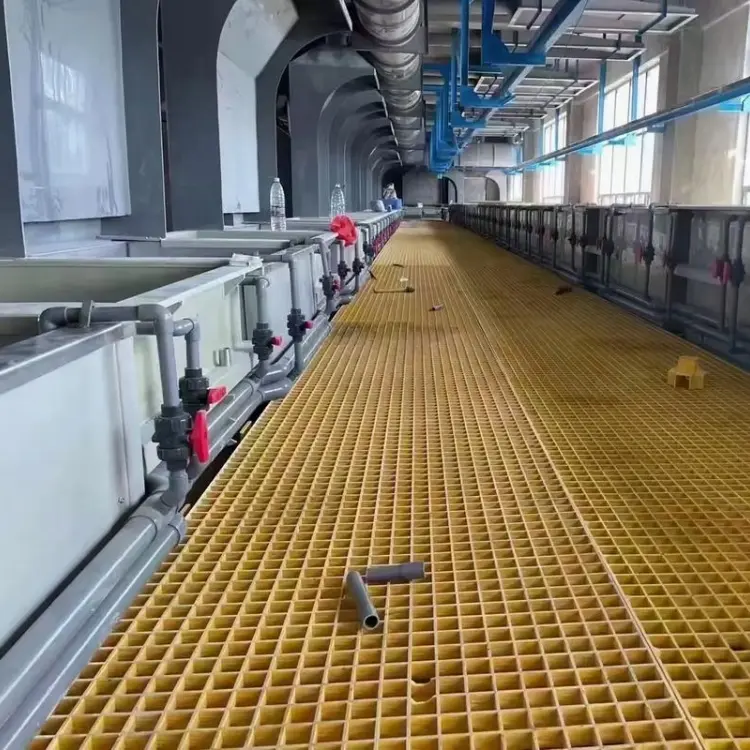
Molded FRP grating is manufactured by interweaving continuous glass fiber rovings into a grid, fully saturating them with thermosetting resin, and curing under heat and pressure. The finished panel is a single, solid piece of composite material.
What makes this different from painted or galvanized steel? The corrosion resistance is integral to the entire cross-section, not applied as a thin outer layer. There is no coating to wear off, crack, or peel. And because this fiberglass grating is non-metallic, electrochemical corrosion — the primary rust mechanism — simply cannot occur.
For wastewater treatment plants, this translates into a walkway that can deliver 15 to 20 years of stable service — a figure validated by long-term performance in harsh municipal and industrial wastewater environments — in conditions that destroy metal in three.
What This Means for Your Plant Operations
You Stop Budgeting for Walkway Replacement
Our molded fiberglass grating requires no painting, no annual anti-corrosion treatment, and no spot repairs. Over a 10-year period, the total cost of ownership for FRP grating can be close to the initial purchase price, while a steel walkway can cost over five times its initial price in replacements and maintenance.
Your Crew Walks on a Safer Surface
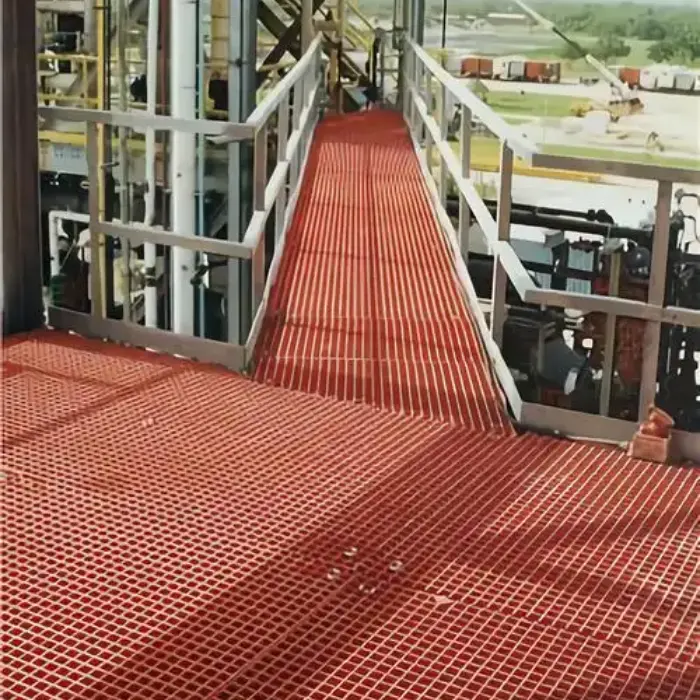
The molding process creates an integral anti-slip texture — concave or grit-topped — across the entire walking area. Even when wet, contaminated, or covered with algae, the surface of this FRP grating maintains a friction coefficient of 0.8 or higher, tested to ASTM standards for slip resistance. No more slipping on rust-scaled steel.
Water and Gas Don’t Accumulate Underfoot
The open grid design allows liquids, sludge, and air to pass through immediately. Walkway surfaces drain fast, preventing puddles. At the same time, airflow through the grating helps disperse harmful gases that can pool above tank surfaces, improving the working environment for your operators.
Electrical Safety Is Built In
FRP grating is non-conductive and tested to withstand 10 kV dielectric strength without breakdown. For plants with nearby electrical equipment, cable trays, or static-sensitive zones, this eliminates electric shock risks that metal walkways inherently carry.
Installation Won’t Disrupt Your Operations
At one-quarter the weight of steel, these composite panels are easy to handle and can be cut on-site with standard power tools — no sparks, no hot work permits. Installation uses stainless steel fasteners and requires no welding. A crew can replace a walkway section in hours, not days.
A Practical Look at Long-Term Costs
Let’s compare a typical 100-square-meter walkway in a municipal wastewater plant:
A traditional hot-dip galvanized steel walkway costs roughly $40 per square meter to install. Every year, maintenance — recoating, spot repair, fastener replacement — runs about 8–10% of that initial cost. By year 5, rust is widespread enough that major sections need replacement. Over 10 years, you’ve spent far more on repairs and downtime than the original walkway ever cost.
An FRP walkway grating costs more upfront per square meter. But there is no annual maintenance line item. No recoating. No unscheduled shutdowns for walkway replacement. And when you do need to replace a panel — typically after 15 years or more — you change only the affected piece, not the whole system.
The financial case becomes clear when you look beyond the initial purchase order and consider the total cost over the plant’s operating life.
Installation: Getting It Right From Day One
A successful FRP grating installation isn’t complicated, but a few practices make the difference between a system that lasts 15 years and one that falls short.
Before You Start
Inspect the existing support beams. Remove rust, welding slag, and sharp edges. If the beams themselves are severely corroded or thinned, reinforce them first. Molded grating is strong, but it relies on a sound support structure.
Cutting and Fitting
Use diamond or silicon carbide blades. The cut is clean, and the process produces no sparks — safe even in areas where combustible gases may be present. After cutting, seal exposed edges with a resin coat to prevent moisture from wicking along glass fibers.
Laying the Panels
Install with the load-bearing bars perpendicular to the support beams. Leave a 3–5 mm gap between panels and against tank walls to allow for thermal movement. Secure each FRP grating panel with our stainless steel fasteners , tightening just enough to hold it firm. Over-tightening can create localized stress points.
Safety During Work
Cover any open tank tops with rigid covers or temporary guardrails before starting. Handle panels carefully to avoid edge damage during transport.
Keeping Your Walkways in Condition
Daily inspections are simple: operators walking the route should note any unusual movement or heavy impact damage and report it.
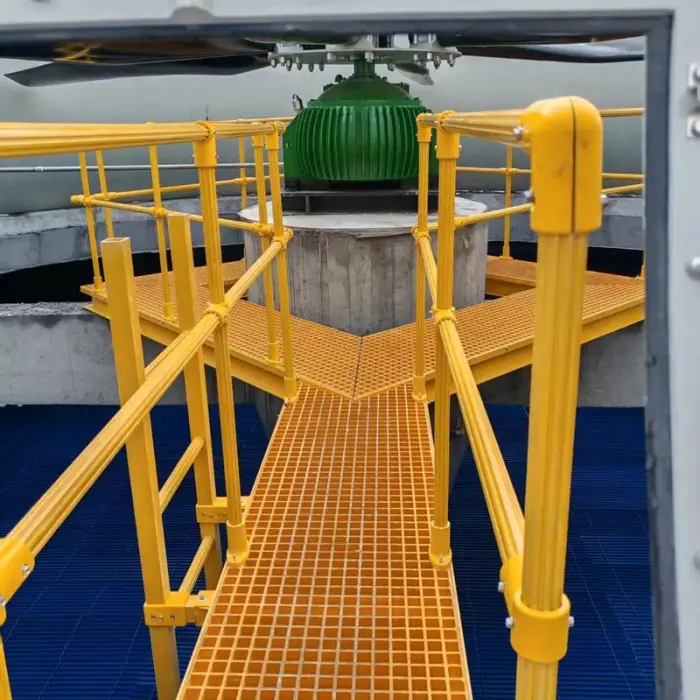
Every six months, conduct a more thorough check. Tighten any loose fasteners. Examine the FRP grating surface for fractures or excessive wear. If a single panel is damaged, you can remove and replace it individually — no need to take apart entire walkway sections.
For cleaning, high-pressure water is all that’s needed. Accumulated sludge, algae, or debris washes off easily. The anti-slip texture does not degrade from normal wear, and the material itself remains unaffected by the corrosive environment.
Questions Plant Engineers Often Ask
Is FRP grating really strong enough for daily foot traffic and equipment?
Yes. Properly specified molded FRP grating offers multi-directional strength and excellent load distribution. It comfortably handles pedestrian traffic and maintenance equipment. For areas requiring vehicle access or heavy loads, we can help you select the appropriate panel depth and reinforcement.
What’s the difference between molded and pultruded FRP grating?
Molded grating has a square mesh pattern and provides strength in all directions, making it ideal for walkways. Pultruded FRP grating has a unidirectional strength profile and is often used in different applications. For wastewater plants, molded grating is typically the better choice because of its integral anti-slip surface and chemical resistance.
How can I get a quote for FRP grating for my plant?
Simply send us your platform dimensions and load requirements. We’ll provide a customized FRP grating solution and a detailed quotation, typically within 24 hours.
A Walkway Shouldn’t Be Your Most Replaced Asset
Pipe racks, pumps, and treatment units are designed for decades of service. The walkways that let your team operate and maintain them deserve the same longevity. Switching to molded fiberglass grating isn’t just about avoiding rust — it’s about permanently removing a recurring cost from your budget and a safety risk from your plant.
If you’re tired of planning the next walkway replacement before the last one is even paid off, let’s talk.
