
Quartz flasks are increasingly chosen for high-temperature distillation when borosilicate glass fails. This case study shows how a new-materials lab eliminated recurring thermal micro-cracks by switching from borosilicate glass to high-purity quartz distilling flasks. If you are facing similar failures above 300 °C, this engineering solution provides a proven, low-risk upgrade path.
Executive Summary
A new-materials lab running an atmospheric high-temperature distillation unit saw its borosilicate glass flasks repeatedly develop thermal micro-cracks when boiling high-boiling solvents above 300 °C. These failures caused frequent experiment shutdowns, scrapped high-value intermediate samples, and created safety hazards.
The lab eliminated the problem completely by replacing all borosilicate glass flasks with quartz distilling flasks and fine-tuning the heating profile. The failure rate dropped to zero, and experimental repeatability improved significantly.
This solution leverages the extremely high softening point and outstanding thermal shock resistance of quartz glass flasks — a straightforward upgrade based on mature, off-the-shelf material properties.
Background and Problem
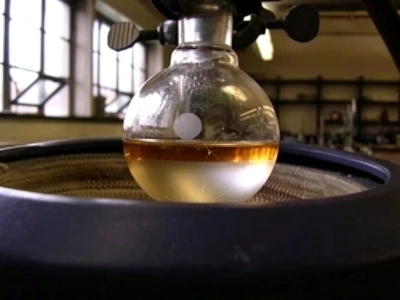
The lab was tasked with atmospheric distillation of a specialty high-boiling solvent, requiring the pot contents to be held at 310–340 °C for long periods. The original setup relied on high-quality 3.3 borosilicate glass round-bottom and distilling flasks. The following issues kept surfacing:
-
After tens of hours of continuous operation, hard-to-see micro-cracks formed where the flask bottom contacted the heating mantle.
-
These cracks progressed to leaks or sudden breakage.
-
Every rupture destroyed the distillation equilibrium, wasting high-value synthetic intermediates and posing a safety risk from spilled hot solvent.
-
Frequent flask replacements consumed significant team hours, delayed the research schedule, and drove up running costs.
Initially, the lab attributed the failures to individual flask quality or heating mantle calibration. They swapped in new flasks of the same type and carefully re-calibrated temperature controls. The thermal cracking recurred regardless, making it clear that borosilicate glass was hitting its performance limit in this temperature range.
Root Cause Analysis
1. Inadequate Thermal Properties of Borosilicate Glass
3.3 borosilicate glass has a linear thermal expansion coefficient of about 3.3 × 10⁻⁶ /°C. Although heat-resistant, continuous heating above 300 °C with localized temperature differences generates thermal stress between the inner and outer walls. This stress approaches the critical threshold for micro-crack propagation. Invisible scratches from the flask manufacturing process easily become stress concentrators, accelerating crack growth.
2. Limited Thermal Shock Resistance
The experiments involved periodic fraction cuts and transient cooling. The flasks were subjected to rapid temperature swings — heating, cooling, and reheating cycles. The thermal shock resistance of borosilicate glass proved insufficient for sustained operation above 300 °C, and micro-crack development far exceeded expectations.
3. Mismatched Operating Range
The distillation equipment was originally rated for a maximum of 250 °C. Pushing it above 300 °C for research purposes without re-evaluating the core vessel material — and continuing to use standard borosilicate glass consumables — inevitably led to failure.
Engineering Solution: Quartz Flasks as Drop-In Replacement
1. Product Replacement — Quartz Flasks / Distilling Flasks
High-purity quartz glass flasks (SiO₂ ≥ 99.9%) were selected to fully replace all borosilicate glass flasks. Key material properties:
| Property | Quartz Flask | Borosilicate Glass |
|---|---|---|
| Softening point | 1730 °C | ~820 °C |
| Continuous-use temperature | 1100–1200 °C | ~500 °C (max recommended) |
| Short-term tolerance | up to 1400 °C | ~600 °C |
| Linear thermal expansion coefficient | 0.55 × 10⁻⁶ /°C | 3.3 × 10⁻⁶ /°C |
| Thermal shock resistance | Can be heated red hot and quenched in cold water without cracking | Limited, cracks under rapid ΔT |
Under lab conditions, even continuous operation at 350 °C cannot cause thermal-stress micro-cracks in Quartz distilling flasks. The flasks remain transparent, making it easy to visually monitor boiling and flooding inside the column.
2. Interface and Accessory Compatibility
Custom quartz distilling flasks were fabricated with standard ground joints matching the existing distillation column. Direct drop-in replacement required no modification to the condenser, temperature ports, or support hardware, minimizing retrofit risk.
3. Heating Profile Adjustment
With the quartz material’s superior thermal shock resistance, ultra-slow preheating is no longer necessary for daily operation. A staged temperature ramp is still followed to avoid unnecessary localized overheating — primarily to protect the heating mantle and temperature probe, not the glass body.
4. Why Choose Quartz Flasks Over Other Vessels?
-
Transparency: Quartz remains transparent for direct visual monitoring.
-
Chemical inertness: It resists most high-boiling organic solvents and many salts.
-
Safety margin: Its softening point far exceeds the maximum experimental temperature, providing a generous safety margin that alternative vessel materials cannot match in this application.

Implementation Steps
-
Equipment Assessment and Flask Specification
Confirm the distillation pot interface, heating mantle cavity dimensions, and select the matching capacity and joint style of Quartz Distilling Flask. -
Direct Replacement and Compatibility Check
Remove the aging borosilicate glass flask, mount the Quartz distilling flask, verify ground-joint sealing, and apply inert sealing grease. -
Trial Run and Run-In
Start with a low-temperature (150 °C) solvent degassing to verify zero leaks at all joints. Gradually ramp to the target 320 °C and run continuously for 48 hours. Record wall temperature, distillation rate, and any visual changes throughout. -
Documentation and Traceability
Log the Quartz distilling flask’s start-up date, batch number, and observations in the lab notebook as part of standard operating procedure.
Results: Zero Failure with Quartz Flasks
After switching to Quartz Distilling Flasks, the unit logged five straight months of high-temperature distillation with noticeably better stability:
-
Thermal cracking eliminated – No micro-cracks or breakage were observed in the flasks during the entire run.
-
Experiment continuity significantly improved – Flask cracking no longer caused interruptions or sample losses. Data reproducibility is far better than before the switch.
-
Overall running costs reduced – Fewer flask replacements cut spending on consumables. Wasted raw materials, solvents, and labor from aborted runs were eliminated.
-
Safer operation – The risk of hot solvent leaks and flying glass fragments dropped sharply, providing a much more reliable foundation for long-term, uninterrupted lab work.
Conclusion
Respect the material’s temperature ceiling.
Borosilicate glass is suited for moderate-temperature work. For any process that will continuously exceed 300 °C, Quartz distilling flasks should be the default choice to ensure uninterrupted experiments.
Quartz reliability stems from mature industrial properties.
High-purity quartz glass has been proven in semiconductors, lighting, and high-temperature optics for decades. Its 1,730 °C softening point and ultra-low thermal expansion are intrinsic product parameters. Bringing this established industrial material into laboratory high-temperature distillation is a straightforward, application-appropriate transfer.
Overall system compatibility matters.
Beyond the flask itself, heating systems, sealing joints, and support clamping must match the quartz flask. In practice, standard ground-joint accessories make the retrofit seamless, allowing the upgrade to be deployed quickly without major modifications to existing equipment.
Frequently Asked Questions About Quartz Flasks
Q1: What is the maximum temperature for quartz flasks?
High-purity quartz flasks have a softening point of 1730 °C and can be used continuously at 1100–1200 °C, with short-term tolerance up to 1400 °C.
Q2: Can quartz flasks replace borosilicate glass flasks directly?
Yes. Custom quartz distilling flasks can be fabricated with standard ground joints, allowing direct drop-in replacement without modifying existing equipment.
Q3: Are quartz flasks transparent?
Yes, high-purity quartz glass flasks remain transparent, making it easy to visually monitor boiling and flooding during distillation.
Q4: Are quartz flasks resistant to thermal shock?
Quartz glass has a very low thermal expansion coefficient (~0.55 × 10⁻⁶ /°C). It can be heated red hot and quenched in cold water without cracking.
Q5: What industries use quartz distilling flasks?
Quartz distilling flasks are used in chemical labs, pharmaceutical research, semiconductor processing, and high-temperature distillation processes above 300 °C.
Related Quartz Products
-
Quartz Distilling Flasks – High-purity quartz flasks for high-temperature distillation.
-
Quartz Glass Tubes – Transparent quartz tubing for high-temperature and optical applications.
-
Custom Quartz Glassware – Custom quartz vessels, joints, and assemblies to your specifications.
Need a Quartz Flask Solution?
If you are experiencing glassware failures above 300 °C, our Quartz Distilling Flasks may be the reliable upgrade you need. Contact our team with your distillation setup details, and we will recommend the right quartz flask size, joint type, and configuration.
