
A gasket sheet isn’t a commodity item you can pick from a catalogue on price alone. The right choice keeps a flange sealed for years; the wrong one means a 3 a.m. callout, lost production, or worse, a safety incident. When a procurement or maintenance team asks me to simplify selection, I always come back to three non-negotiable factors: temperature, pressure, and media. Once you define those, the material shortlist writes itself.
Below is a field-driven breakdown of the four workhorse gasket sheet materials you’ll encounter across refineries, chemical plants, power stations, and food processing. The table at the end condenses the critical numbers into one reference.
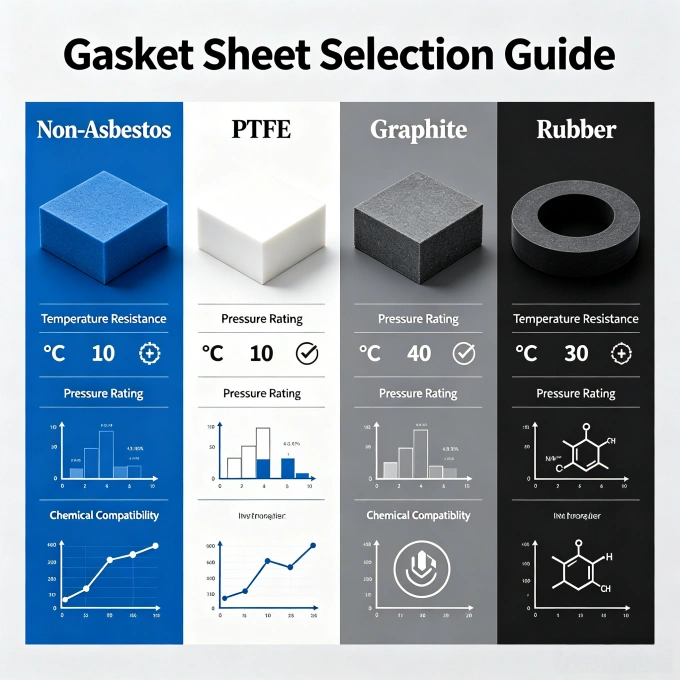 1. Compressed Non-Asbestos (CNA) – The Generalist
CNA sheets, typically aramid fibre bound with NBR or SBR, replaced asbestos in most general-purpose applications. You’ll find them on water, air, mild chemicals, oils, and low-pressure steam.
Where it makes sense: Cooling water circuits, air compressors, gearbox flanges, and light hydrocarbon service. For oil resistance, specify NBR-bound grades; for potable water, specify WRAS-approved grades with SBR. The material handles moderate bolt loads and forgives surface irregularities better than brittle options.
Where it falls short: Avoid CNA on saturated steam above 200°C or aggressive acids and alkalis. The binder burns out in a fire, leaving a leak path. Also, don’t use it for vacuum service unless the grade is specially reinforced.
Key point for buyers: There’s a huge quality spread. A low-tier CNA sheet might delaminate at 150°C. Always ask for the DIN 28091-2 or ASTM F104 test data, not just the marketing brochure.
2. Flexible Graphite – The High-Temperature Workhorse
Reinforced flexible graphite sheet (usually laminated with a 0.1 mm stainless steel foil) is the default answer for high-temperature, high-pressure steam, heat transfer fluids, and most chemicals except strong oxidizers.
Where it makes sense: Saturated and superheated steam, thermal oil systems, refinery piping, and any service where a blowout would cause a fire. Graphite holds its seal from cryogenic temperatures right up to 450°C in steam and 300°C in oxidizing atmospheres. It resists creep exceptionally well under bolt load, so retorque cycles are fewer.
What catches users out: Graphite is electrically conductive, promoting galvanic corrosion on stainless steel flanges if a wet electrolyte is present. In nitric acid, oleum, or hot concentrated sulfuric acid service, graphite will oxidize rapidly. Also, never install it on flanges with sharp serrations that can cut the foil reinforcement.
Procurement tip: Check the carbon content. 98% minimum pure graphite gives the best performance. Lower grades contain more ash and can harden prematurely at temperature.
3. PTFE (Skived & Molded) – Chemical Resistance First
Virgin PTFE sheet handles the most aggressive chemical environments—strong acids, caustics, solvents, and high-purity media. It’s also the go-to for food and pharmaceutical lines because nothing leaches into the product.
Where it makes sense: 98% sulfuric acid, hydrochloric acid, caustic soda, CIP fluids, oxygen-enriched service, and any line requiring FDA 21 CFR 177.1550 compliance.
The real-world problem: PTFE cold-flows. Under sustained bolt load and thermal cycling, the material extrudes out of the flange gap, and the gasket stress relaxes. A leak appears not because the material failed chemically, but because it walked out of the seal. You combat this with filled PTFE grades (barium sulfate, silica) for stiffer, more dimensionally stable behavior, or with contoured gasket profiles that lock material in place.
When to choose ePTFE over skived PTFE: If flange surfaces are pitted or misaligned, expanded PTFE (ePTFE) is far more compressible. It can seal at bolt loads as low as 5 MPa, making it ideal for glass-lined equipment, plastic flanges, and heat exchangers with thin divider plates. Virgin ePTFE maintains the same chemical resistance as skived PTFE but conforms better.
4. Temperature Extremes: Mica & Ceramic Fiber
When graphite hits its upper limit around 450°C, you need a mica-based sheet, often layered with stainless steel. These handle exhaust gas, gas turbines, and emergency fire zone seals up to 900°C. Ceramic fiber with vermiculite binder works similarly but offers better resistance to vibration. These materials are niche, expensive, and not stocked by every distributor, but they solve applications where nothing else survives.
Selection by Application Scenario
Saturated steam (up to 200°C, 16 bar)
CNA (aramid/NBR) with a 2 mm thickness works. But if water treatment is inconsistent and the steam is slightly superheated, step up to flexible graphite to eliminate burnout risk.
Superheated steam or thermal oil (250–450°C)
Flexible graphite with 316L foil reinforcement, 1.5–2 mm thick. Don’t accept pure graphite without reinforcement on flanges above DN 50; it lacks the tensile strength to stay in place.
Strong acids (sulfuric, nitric, HCl)
Virgin or filled PTFE, depending on flange distortion. If it’s a glass-lined vessel with low bolt torque, use 3 mm ePTFE. For a steel flange with decent bolts, filled PTFE gives better blowout resistance.
Oil and fuel lines
CNA with NBR binder or graphite. If the oil is hot (>150°C), graphite wins. Watch for aromatics that attack NBR.
Food and pharmaceutical
White, virgin ePTFE or skived PTFE. Confirm certificates: FDA, EC 1935/2004, and preferably a 3.1 material certificate. Avoid any grade with added pigment that isn’t food-approved.
Oxygen service
PTFE only, cleaned and bagged per ASTM G93 oxygen cleaning standards. No graphite, no organic binders.
Material Parameter Comparison Table
| Material Type | Continuous Temp. Range | Max Pressure (bar, typical for 2 mm) | pH Range | Suitable Media | Key Limitation |
|---|---|---|---|---|---|
| Compressed Non-Asbestos (Aramid + NBR) | -40°C to 200°C (oil); 180°C (water/steam) | 80 (DN 40) | 4–11 | Water, oils, mild acids/alkalis, refrigerants | Binder burns out above 200°C; poor steam resistance in superheated conditions |
| Compressed Non-Asbestos (Aramid + SBR) | -30°C to 150°C | 60 | 6–10 | Potable water, general services | Not oil-resistant; limited chemical compatibility |
| Flexible Graphite (reinforced with 316L foil) | -200°C to +450°C (steam/neutral); +300°C (oxidizing) | 110 | 0–14 (except strong oxidizers) | Steam, heat transfer fluids, hot oils, most chemicals | Oxidizes in concentrated nitric, sulfuric (hot), oleum; promotes galvanic corrosion |
| Virgin PTFE (skived) | -100°C to +260°C | 35 (at 200°C) | 0–14 | Aggressive acids, alkalis, solvents, food, oxygen | Cold flow under high bolt load; requires retorquing; low blowout strength |
| Expanded PTFE (ePTFE) | -200°C to +260°C | 30 | 0–14 | Same as PTFE but ideal for irregular or fragile flanges | Lower tensile strength; can be extruded if gap is large |
| Mica (reinforced with SS316) | Up to +900°C | 40 | 0–14 (up to temp) | Exhaust gas, fire seals, gas turbines | Low flexibility; requires high bolt load; expensive |
*Note: Maximum pressure values depend heavily on gasket thickness, flange size, and bolt load. The figures above represent practical limits for a 2 mm gasket in a standard raised-face flange at moderate bolt torque. Always refer to the manufacturer’s specific m and Y values or p×T diagram for critical services.*
