
Bubble level vials show up everywhere that accuracy matters—construction, machinery alignment, equipment commissioning, interior finishing. They’re simple tools, but how they get mounted and handled decides whether they stay trustworthy.
1. Before Installation
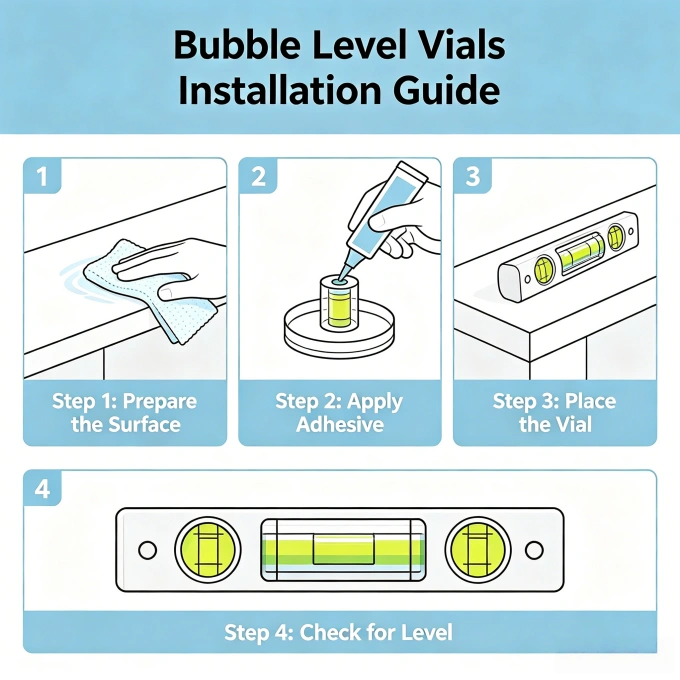
Start with the surface. Clean it thoroughly so it’s flat, dry, and free of dust, grit, or raised spots. Any bump under the vial body tilts the reading right from the start.
Examine the vial itself. The glass tube should be intact, free of cracks or clouding. Check that the bubble hasn’t split or drifted into one end when the vial sits on a known level surface. The graduation lines must be sharp and legible. If the bubble is sluggish, the tube may have lost fluid—set it aside and grab a fresh one.
2. Fixing the Vial in Place
Adhesive-backed vials
Peel the protective film from the backing. Position the vial on the cleaned surface and press it down firmly from the center outward. Work slowly so no air gets trapped and no edge lifts. Once seated, leave it undisturbed for a few minutes to let the adhesive bite. If the surface temperature is very low, warming it slightly before application improves the bond.
Screw-fixed vials
Align the mounting holes with the pre-drilled or tapped points on the equipment. Start every screw by hand to avoid cross-threading. Then tighten them gradually in a diagonal sequence—just like you would on a flange. Even torque prevents the base from warping, which throws off the bubble. On thin metal panels, add backing washers to stop the screws from pulling through over time.
 Recessed or embedded vials
 Recessed or embedded vials
Slide the vial into the machined slot or pocket. It should fit snugly without being forced. A light press or a retaining plate holds it in place. After securing, grab the vial body and try to rock it by hand. Any movement here will magnify into a wandering bubble under vibration. Shim or reseat as needed until it’s dead solid.
3. Reading and Adjusting
Set the equipment—or a reference bar if the vial is standalone—onto the surface you want to check. Let the bubble settle. When it floats exactly between the center marks, the surface is level (or plumb, if the vial is mounted vertically).
If the bubble drifts to one side, that side is the high side. Lower it or raise the opposite side in small increments until the bubble centers. On screw-adjusted mounts, make tiny turns and watch the bubble react. Patience here pays off more than chasing the bubble back and forth.
4. Keeping It Accurate
Treat the vial as a measuring instrument, not a rough guide. A sharp knock against a steel beam or a drop onto concrete can shift the glass tube inside the housing—once that happens, the zero point is gone. If a vial takes a hit, check it against a reliable reference surface before trusting it again.
Heat and direct sun are just as damaging. Long exposure evaporates the damping liquid inside the tube, leaving a smaller, jumpy bubble or none at all. Store vials in a cool, shaded place, ideally flat in a drawer or case.
Vials that see continuous vibration or temperature swings can work loose over time. Make it a habit to verify calibration periodically. Mount a known-good master level on the same surface, compare readings, and if the vial has drifted, reseat or replace it. A quick routine check catches problems before they translate into misaligned machinery or out-of-plumb walls.
Everything described here is standard shop-floor practice. The difference between a level that holds true for years and one that lies to you comes down to a clean mounting surface, even fastening pressure, and a little respect for the glass tube inside.
