
A gasket fails when the material doesn’t fit the conditions it actually sees. Not the nameplate conditions a floor away. The temperature, pressure, and chemical attack right at the flange face. Get the match right and the joint stays sealed for years. Get it wrong and you’re shutting down to scrape gasket debris off a pitted surface. This guide lays out the choices plainly, so you can buy the right gasket from the start.
What Drives Gasket Choice?
Before looking at materials, settle five things about the joint.
Temperature at the seal. Use the maximum upset temperature, not the normal running temperature. A process that runs at 150°C normally but swings to 280°C during a cleaning cycle needs a gasket rated for the peak.
Pressure in the system. Bolted joint pressure and hydrostatic test pressure matter. Spiral wound and metal-jacketed gaskets handle far more than plain sheet materials.
The fluid or gas. Chemical compatibility is not guesswork. A weak acid at room temperature and a hot concentrated acid attack materials differently. Always check the gasket material’s resistance chart against your full media list.
Flange type and face finish. Raised face, flat face, tongue-and-groove, ring joint — the gasket style must match the geometry. A thick soft gasket on a narrow tongue-and-groove flange will extrude. A spiral wound gasket on a flat face cast iron flange may crack the flange if over-torqued.
Bolt load available. Large, soft gaskets need uniform bolt stress to seal. If your flange has light bolting, a harder gasket or one with controlled compressibility (like spiral wound) often works better.
With those figures in hand, the options narrow fast.
 Gasket Materials and Where They Fit
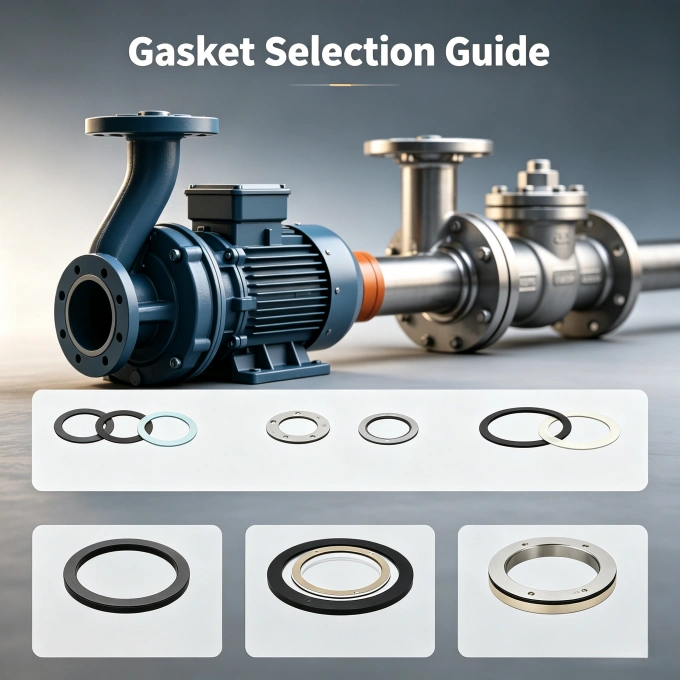 Gasket Materials and Where They Fit
Non-Asbestos Gasket Sheets
Non-asbestos sheets replaced asbestos across most general industrial gasketing. They are fiber-reinforced sheets with a rubber or resin binder. Different fiber and binder combinations shift the temperature and chemical resistance.
Standard grades handle water, steam, oils, and many mild chemicals up to about 200-300°C depending on the binder. Higher-spec grades with aramid fiber and NBR or SBR binders go higher and stand up to more aggressive fluids. This is the default choice for pipe flanges, pump casings, valve bonnets, and vessel manways where conditions aren’t extreme.
Do not run non-asbestos sheets above the binder’s rated temperature. The binder burns out first, leaving porous fiber that leaks and can’t be re-tightened.
Graphite Gaskets
Flexible graphite — often reinforced with a metal insert or laminated onto a steel core — works where it gets hot and where chemicals attack organic binders. Graphite handles steam up to 450°C and, in non-oxidizing environments, can go higher. It resists nearly all chemicals except strong oxidizers like nitric acid and oleum.
Use graphite gaskets on steam lines, heat exchangers, boiler handholes, and high-temperature flanges in refineries and power plants. Graphite also covers a wide pH range, which makes it useful across chemical processing.
Note the galvanic corrosion risk. Graphite is cathodic to many metals. On stainless steel flanges with conductive fluids, specify inhibited graphite or verify that your operating conditions won’t eat the flange face over time.
PTFE Gaskets
PTFE (polytetrafluoroethylene) has the broadest chemical resistance of any gasket material. pH 0 to 14, solvents, aggressive acids, food products — PTFE handles them. The temperature ceiling sits around 260°C.
Pure PTFE creeps under load and relaxes, so it is often used as a skived sheet, envelope gasket, or filled grade. Glass-filled PTFE reduces cold flow. A PTFE envelope over a compressible core combines chemical resistance with better recovery.
PTFE is the go-to for corrosive chemical lines, pharmaceutical processing, food and beverage piping, and anywhere product contamination is the overriding concern. Avoid pure PTFE on wide raised-face flanges with heavy thermal cycling — the gasket can thin and blow out. A filled or reinforced grade holds up better.
Rubber Gaskets
Rubber gaskets cover a family of elastomers, each with a narrow chemical niche. Material choice is specific to the fluid and temperature.
-
NBR (Nitrile) — good with oils, fuels, and water up to about 100°C.
-
EPDM — excellent for hot water, steam up to 150°C, and polar solvents; not for mineral oils.
-
Silicone — high temperature for an elastomer (up to 230°C), good for dry heat and some food contact; poor in fuel and oil.
-
SBR — general water and mild chemical service, low cost.
-
Viton/FKM — aggressive fluids including some acids and hydrocarbons, up to 200°C or more.
Rubber gaskets seal at low bolt loads, which makes them suitable for lightweight flanges, plastic piping, ductwork, and water treatment equipment. They are not designed for high pressure or high bolt torque — crushing a rubber gasket by overtightening destroys its recovery.
Spiral Wound Gaskets
Spiral wound gaskets combine a V-shaped metal strip wound alternately with a soft filler, usually graphite or PTFE, with a metal outer centering ring and sometimes an inner ring. The metal gives strength and blowout resistance; the filler gives the seal.
These gaskets handle the highest pressures and widest temperature swings. In refineries, petrochemical plants, and power stations, spiral wound gaskets sit in pipe flanges from class 150 to class 2500, often up to 250 bar and through temperature cycles that would chew up a softer sheet gasket.
Select the metal winding and filler to match the process. 304 stainless steel with graphite filler is a standard combination. For very corrosive fluids, 316L, duplex, or higher alloys with PTFE filler are common.
Spiral wound gaskets need a reasonable flange face finish and proper centering. Never reuse a spiral wound gasket — the winding relaxes permanently once compressed.
Exhaust Gaskets
Exhaust gaskets are a specialized category for engine and turbine exhaust flanges, manifolds, and turbocharger connections. The gasket must resist high temperatures — often above 600°C — and tolerate vibration, thermal expansion, and constant bolt load changes.
Materials range from multi-layer embossed steel and graphite composite sheets to metal-reinforced fiber facings. A common construction is a stainless steel core with a graphite or mica facing. Some high-performance exhaust gaskets are all-metal with a compressible bead.
In the B2B market, buyers source these for engine remanufacturing, exhaust system assembly, and industrial turbine work. When ordering, provide the exact flange shape or part number — many exhaust gaskets are profile-cut rather than standard rings.
Asbestos Gaskets
Asbestos gaskets still appear in some legacy specifications, but the material belongs in the past. Health risks from airborne fibers during cutting, handling, and removal are well established. Modern non-asbestos and graphite products match or exceed asbestos performance in every category.
If a drawing or maintenance spec still calls for an asbestos gasket, reject it and propose a like-for-like substitution. A high-quality non-asbestos sheet or a graphite laminate will fit the same joint, meet the same temperature and pressure requirements, and eliminate the liability.
Gasket Selection Table
| Gasket Type | Max Temperature | Max Pressure (typical) | pH / Chemical Suitability | Common Applications |
|---|---|---|---|---|
| Non-Asbestos Sheet | 200–400°C (binder dependent) | 40–50 bar | Water, oils, steam, mild chemicals | General pipe flanges, pumps, valves, vessel covers |
| Flexible Graphite (reinforced) | 450°C (oxidizing), higher in inert | 100 bar | 0–14 (avoid strong oxidizers) | Steam lines, heat exchangers, boilers, chemical flanges |
| PTFE (virgin or filled) | 260°C | 50 bar | 0–14 (almost all chemicals) | Acid and solvent lines, food, pharma, sanitary |
| Rubber (NBR, EPDM, Silicone, etc.) | 100–230°C (type dependent) | 10–16 bar | Varies by rubber type | Water treatment, ducting, low-pressure piping |
| Spiral Wound (metal + filler) | Up to 1000°C (metal dependent) | Up to 250 bar | Wide, filler dependent | Refinery, petrochemical, high-pressure steam, HTF lines |
| Exhaust Gasket (composite or all-metal) | 600–800°C+ | Medium to high | Exhaust gases | Engine manifolds, turbo flanges, exhaust piping |
| Asbestos | 350–400°C | 40 bar | Wide (historical) | Legacy equipment only — do not specify for new builds |
Note: Pressure ratings are indicative and drop as temperature rises. Always verify against the manufacturer’s P-T chart for the specific grade.
Matching Gasket to the Job: Application Scenarios
General Water, Oil, and Utility Lines
For everyday pipe flanges carrying water, compressed air, light oils, or low-pressure steam below 200°C, non-asbestos sheet gaskets are the standard choice. They offer dependable sealing at reasonable cost and are stocked in a wide range of flange sizes. If the fluid is drinking water, check WRAS or NSF 61 compliance. For hot water and low-pressure steam, EPDM rubber gaskets also work well on grooved couplings and light flanges.
Steam and High-Temperature Service
Once the temperature climbs past 250°C, non-asbestos starts to fall off and graphite becomes the default. Reinforced graphite gaskets seal saturated and superheated steam lines, heat exchanger flanges, and boiler accessories. In power and process plants, spiral wound gaskets are often specified for critical steam joints because they tolerate pressure surges and thermal cycling without relaxing.
Corrosive Chemicals and Acids
PTFE is the first material to consider. For hydrochloric, sulfuric (in many concentrations), caustic soda, and solvent lines, PTFE provides near-universal resistance. If the line pressure is high or the flange is wide, choose a filled PTFE or PTFE envelope gasket to prevent creep. Graphite can step in for many corrosive services as long as oxidizers are absent. Avoid any rubber or non-asbestos gasket here unless the specific chemical compatibility has been verified with the manufacturer.
High-Pressure Hydrocarbons and Refinery Services
Spiral wound gaskets dominate this space. A 316L stainless steel winding with graphite filler covers most hydrocarbon, steam, and hot oil duties in refineries and petrochemical plants. For very sour service, follow NACE MR0175 guidelines on metal winding hardness. Always specify the gasket with an outer ring for centering and, where required, an inner ring to protect the winding from media attack and turbulent flow.
Food, Beverage, and Pharmaceutical Lines
Cleanability, non-toxicity, and non-absorptive properties matter above all. Virgin PTFE gaskets, often in sanitary clamp or tri-clamp profiles, are used throughout food and pharma processing. Silicone and EPDM rubber gaskets also appear in hygienic unions and quick-connect fittings where frequent disassembly is needed. All materials should carry FDA or EU food contact compliance documentation.
Engine and Exhaust Systems
Exhaust gaskets are designed for a single harsh job: high heat, lots of vibration, and constant thermal expansion and contraction. Multi-layer steel gaskets with a compressible sealing bead or graphite composite facings are common on diesel and gas engines, turbos, and industrial exhaust ducting. When buying for aftermarket or OEM assembly, confirm the temperature rating matches the combustion gas outlet temperature, not just the manifold surface temperature.
Common Ordering Mistakes
Guessing the size. A gasket cut from memory or from an old part without measuring the flange often fits poorly and leaks. Always measure the flange inner and outer diameters or pull the dimension from the flange standard.
Mixing up pressure classes. A gasket sized for a PN16 flange won’t automatically suit an ANSI 150 flange. Bolt circles and raised face dimensions differ.
Ignoring the test condition. The hydrostatic test pressure after a shutdown can exceed the normal operating pressure. Make sure the gasket holds at the test condition too.
Picking the cheapest material without a spec. A low-cost non-asbestos gasket thrown into a hot chemical line saves pennies on the invoice and costs the plant a shutdown. Define the full operating envelope before you send the purchase order.
Not asking for the data sheet. Every reputable manufacturer publishes a P-T diagram and chemical compatibility list. If your supplier won’t provide one, the gasket material is an unknown — and an unknown gasket is a liability.
A Word on Standards
Where possible, reference known standards in your purchasing specification. ASME B16.20 covers spiral wound gaskets for pipe flanges. ASME B16.21 covers non-metallic flat gaskets. EN 1514 and DIN standards apply in European markets. For food and water, FDA, WRAS, and NSF 61 are common.
When you send an RFQ, list the standard, the material, the flange class or pressure rating, and the exact dimensions. A clear spec gets a clean quote. If your application sits near the edge of a material’s capability, speak to an engineer before ordering bulk stock — a short conversation prevents a container of gaskets that can’t handle the job.
