
In industrial construction, infrastructure maintenance, and high-end manufacturing, material engineers and procurement managers keep running into the same problem: finding a profile that’s lightweight, strong, and genuinely corrosion-proof for the long haul. The answer almost always points to FRP profiles. But with everything from Fiberglass Angle to FRP rectangular tube on the market, the options are vast and the technical details matter. Specify the wrong profile, and you risk structural issues across the entire project.
This guide breaks down FRP profile selection logic, product specifics, material comparisons, and the most common buying mistakes—all from a hands-on, professional perspective.
1. FRP Profile Selection Guide
Factor 1: Define the service environment
Check whether the profile will be exposed to salt spray, acids, alkalis, or solvents. Determine indoor or outdoor use, and understand UV intensity. The environment directly dictates the corrosion resistance and weatherability grade you need.
Factor 2: Map the load path
Clarify if the part is decorative, secondary support, or primary load-bearing. Based on this, select from angle, I-beam, tube, channel, or flat strip. For main load-bearing members, always go with a profile that delivers a high section modulus.
Factor 3: Choose the right resin
The resin system determines corrosion resistance, mechanical strength, and thermal limits. Start with the basic resin categories below, then refine your choice using the detailed material selection comparison that follows.
Polyester: Lower cost, suitable for general environments.
Vinyl ester: Superior chemical resistance; the first choice for acid, alkali, and salt exposure.
Epoxy: Best mechanical strength and interfacial bonding; use when requirements are extreme.
Choosing the right FRP profile is not just about strength—it is about matching the resin system to the chemical, thermal, and mechanical demands of the application. The table below summarizes resin-based selection logic for typical industrial environments:
| Exposure Condition | Recommended Resin | Reason | Avoid |
| Mild chemical / atmospheric corrosion, neutral pH | Polyester | Cost-effective, adequate durability | Vinyl ester / epoxy (over-spec, cost increase) |
| Strong acids (sulfuric, hydrochloric, phosphoric) | Vinyl ester | Superior acid resistance, prevents resin hydrolysis | Polyester (rapid degradation) |
| Alkaline environments (caustic soda, ammonia) | Vinyl ester | Excellent alkali resistance | Polyester (ester groups vulnerable to saponification) |
| Bleach, chlorine, oxidizing chemicals | Vinyl ester or epoxy | Oxidation-resistant backbone | Polyester |
| Organic solvents (toluene, MEK, alcohols) | Epoxy | High crosslink density resists solvent attack | Polyester / vinyl ester (swelling risk) |
| Combined high temperature + chemical exposure (>90°C) | Epoxy (high Tg grades) | Maintains strength at elevated temperature | Polyester (softens early) |
| High mechanical fatigue / dynamic loads | Epoxy | Highest interfacial bond and fatigue resistance | Standard polyester |
| Outdoor long-term weathering + UV | Vinyl ester or polyester with UV stabilizers | Additives/veil protect resin-rich surface | Untreated polyester (chalking, fiber bloom) |
| Electrical insulation, >10kV safety zones | Vinyl ester or epoxy | Track resistance, low leakage current | Any system with carbon or metal filler |
Factor 4: Check temperature and fire requirements
FRP profile performance depends heavily on the resin. Pin down the expected service temperature and any fire performance needs early. For projects with fire regulations, always verify the flame spread rating and smoke density.
Factor 5: Factor in fabrication and installation
Assess how easy it is to cut, drill, connect, and handle on site. Confirm these points with the installation crew before finalizing the spec.
Factor 6: Request drawings or sample lengths
For custom or high-volume jobs, demand a cross-section drawing and get sample sections for a trial fit. This prevents assembly headaches caused by dimensional drift and lets you inspect fiber distribution and internal quality firsthand.
2. FRP Profile Products Overview
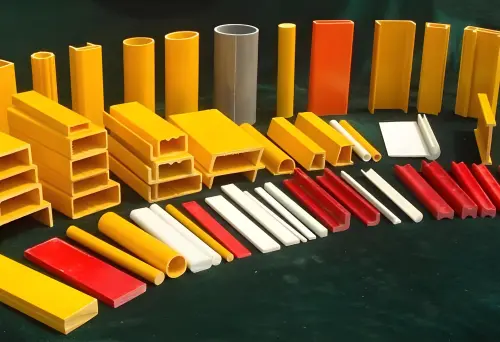
Our full line of FRP profiles is manufactured using a continuous pultrusion process, delivering consistent cross-sections and dependable performance. Here’s what makes each profile stand out:
Fiberglass Angle (FRP Angle)
A standard equal-leg profile with powerful corner support strength and excellent corrosion resistance. Designed for structural bracing, fabrication, and corrosive-duty components. Ideal for frames, brackets, equipment assemblies, cable management structures, and custom industrial builds. The angle is easy to cut, has low electrical conductivity, and performs reliably in wet, chemically aggressive, or coastal environments.
FRP I-Beam
Engineered for structural spans that demand high stiffness with minimal weight. Perfect for platforms, support frames, walkways, cable tray structures, equipment bases, and custom fabrication projects.
FRP Rod
A solid, non-metallic round profile that holds its performance in harsh conditions. Suited for structural supports, reinforcement, spacers, hand tool components, and custom fabrication. It’s an ideal replacement for steel rebar, especially where rust, electrical conductivity, or excess weight cause problems.
FRP Flat Strip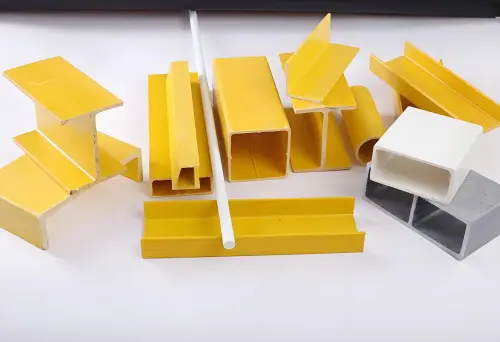
A straightforward, highly versatile flat bar used as stiffeners, shims, backing strips, and light structural ties. A go-to material for cable tray fittings, support assemblies, equipment frames, and custom projects. Easy to cut, drill, and assemble—making it perfect for maintenance work, equipment retrofits, and corrosion-resistant framing.
FRP Rectangular and Square Tube
The first choice for structural framing. Ideal for handrail systems, support structures, equipment components, and custom industrial manufacturing. Rectangular tube is commonly used as handrail beams; square tube serves as posts. Together, they form fully insulated, acid- and alkali-resistant access platforms or railing systems.
FRP U Channel
A strong fit for frames, support structures, equipment components, cable-related structures, and custom fabrication. Widely used for edge protection, rail guides, frame building, and light structural reinforcement. Its open-channel design makes installation, alignment, and securing cables or panels simple and fast. In tough environments, the FRP U-channel shrugs off corrosion, moisture, and a broad range of industrial chemicals.
FRP Round Tube
Built for applications that call for a smooth appearance, directional consistency, or unique installation geometry. FRP round tube works well in projects needing lightweight, durable, corrosion-resistant round profiles with consistent dimensions. Typical uses include structural supports, handrails, columns, chemical plants, marine structures, light-duty frames, boat components, antenna mounts, and specialty structural parts.
3. FRP Profiles vs. Other Common Materials — A Quick Comparison
| Performance Metric | FRP Profiles | Carbon Steel | Stainless Steel | Aluminum | Wood |
| Density & Weight | Extremely lightweight | Heavy | Heavy | Light | Lighter |
| Corrosion Resistance | Excellent (resists acid, alkali, salt) | Poor, rusts easily | Good (susceptible to chlorides) | Fair, galvanic corrosion risk | Easy to rot |
| Tensile / Flexural Strength | High | Very high | Very high | Moderate | Low |
| Electrical Insulation | Excellent (insulator) | Conductive | Conductive | Conductive | Fair |
| Thermal Conductivity | Very low (insulating) | High | High | High | Low |
| Thermal Expansion | Lower | Low | Low | Higher | Low |
| Installation & Fabrication | Easy to cut, non-sparking | Requires welding, heavy | Requires TIG welding | Requires TIG welding | Simple |
| Lifecycle Cost | Low (maintenance-free) | High (needs anti-corrosion treatment) | Higher | Moderate | Low (short lifespan) |
| Typical Applications | Walkways, handrails, platforms, cable trays, marine structures | Frames, beams, equipment supports, industrial manufacturing | Food equipment, process systems, outdoor structures, marine hardware | Light structures, transportation, enclosures, interior frames | Temporary structures, general construction, low-load frames |
Key Mechanical Properties of Pultruded FRP Profiles
The mechanical performance of FRP profiles is determined primarily by the resin matrix and glass fiber reinforcement. The table below provides typical property ranges for pultruded profiles made with polyester, vinyl ester, and epoxy resins, tested in the longitudinal (fiber) direction. Use these values as design benchmarks when evaluating load-bearing capacity.
| Property | Test Method | Polyester FRP | Vinyl Ester FRP | Epoxy FRP |
| Fiber Volume Fraction | – | 45–60% | 50–60% | 55–65% |
| Density (g/cm³) | ISO 1183 | 1.75–1.95 | 1.80–2.00 | 1.85–2.10 |
| Tensile Strength (MPa) | ASTM D638 / ISO 527 | 300–450 | 350–500 | 400–600 |
| Tensile Modulus (GPa) | ASTM D638 / ISO 527 | 20–25 | 22–28 | 25–35 |
| Flexural Strength (MPa) | ASTM D790 / ISO 178 | 300–500 | 350–550 | 400–650 |
| Flexural Modulus (GPa) | ASTM D790 / ISO 178 | 12–18 | 14–20 | 18–30 |
| Compressive Strength (MPa) | ASTM D695 | 200–300 | 220–320 | 250–400 |
| Impact Strength (kJ/m², Charpy) | ISO 179 | 80–150 | 90–180 | 100–220 |
| Barcol Hardness | ASTM D2583 | 40–55 | 45–60 | 50–70 |
| Water Absorption (% max) | ISO 62 | 0.5–1.0 | 0.2–0.5 | 0.1–0.3 |
| Heat Deflection Temperature (°C) | ASTM D648 @1.82MPa | 65–80 | 90–110 | 100–150 |
When weight-normalized, FRP profiles offer specific tensile strengths 2–3 times that of carbon steel, while eliminating corrosion-related maintenance and ensuring lifecycle cost advantages in aggressive environments.
4. Matching FRP Profiles to Application Scenarios
Data sheets only get you so far. Here are field-tested combinations that work in real projects:
4.1 Chemical & Corrosion-Resistant Platforms
Go-to combination: FRP I beam (main beams) + FRP square tube (columns) + FRP channel (grating supports) +Fiberglass angle (edging).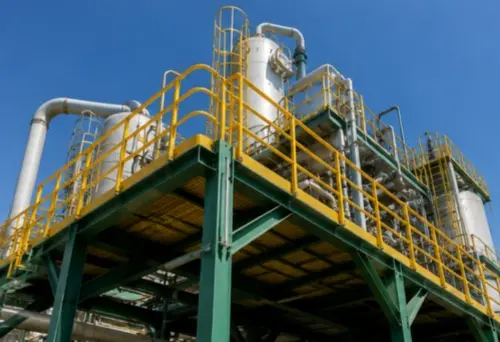 Why it works: The entire structure fights corrosion as a system. No hot work or welding needed—just assemble with FRP bolts and connectors. This completely eliminates the platform collapse risks that come from weld slag rust and hidden corrosion.
4.2 Electrical & High-Voltage Environments
Go-to combination: FRP round tube (handrails) + FRP U-channel (cable trays) + Fiberglass rod (operating poles).
Why it works: In areas above 10kV, metal components easily generate induced voltage. FRP’s insulating properties
deliver 100% safety assurance for operations and maintenance crews.
4.3 Wastewater Treatment & Marine Engineering
Go-to combination: FRP rectangular tube (railing beams) + FRP square tube (intermediate posts) + FRP anti-slip grating tread (stair treads).
Why it works: Seawater and chemical-laden wastewater can cause rapid pitting corrosion on stainless steel. Thick-wall pultruded FRP profiles routinely deliver a 20-year plus service life in these conditions.
5. Five Common Buying Mistakes
Comparing by weight alone and ignoring cross-sectional mechanical properties
Never select FRP profiles by price per kilogram. Thinning the wall cuts cost, but structural stiffness drops drastically. Always check moment of inertia data. Verify structural members by stiffness, not just wall thickness—ask: “Does it carry the load?”
Confusing FRP with acrylic
Translucent daylighting panels (acrylic/Plexiglas) are thermoplastics with practically zero structural strength. Load-bearing members must be thermosetting resin reinforced with continuous fiberglass and made via pultrusion. The two materials are chemically different—never substitute one for the other.
Ignoring fastener compatibility
Connecting FRP profiles with carbon steel bolts causes rust bleeding along the joint, which eventually cracks the profile. The entire assembly must use stainless steel or FRP-specific fasteners. No exceptions.
Falling for “pure resin” or fake fiberglass low-price traps
A “fiberglass rod” with a glossy, wax-like surface and no visible fiber pattern is often just pure plastic. Two field checks: Burn it—real FRP gives off black smoke and leaves behind white fibers. Cut it—real FRP shows a rough cross-section with dense, broken fiber ends; fakes have a smooth cut face.
Ignoring dimensional tolerances and causing assembly interference
In precision-fit assemblies, a 1 mm profile deviation can make installation impossible. Always specify pultrusion dimensional tolerance standards, and require the supplier to ship batch dimensional reports with the order.
6. A Note on Standards
Inconsistent quality across the FRP market often comes down to which standards a manufacturer follows. Here’s what to look for:
Common standards:
EN 13706 for pultruded structural profiles
ASTM test methods for tensile, flexural, and impact validation
Project-specific fire, smoke, or electrical performance requirements
Common certifications:
ISO 9001 quality management
ISO 14001 environmental management
RoHS / REACH declarations for export markets
