
Executive Summary
A packaging equipment manufacturer explored replacing metal gears with nylon gears to solve noise and inertia issues in high-speed automation. By switching from 40Cr steel to [cast nylon (PA6G) gears] in low-to-medium load drives, the equipment achieved quieter operation, less maintenance, and faster motion response.
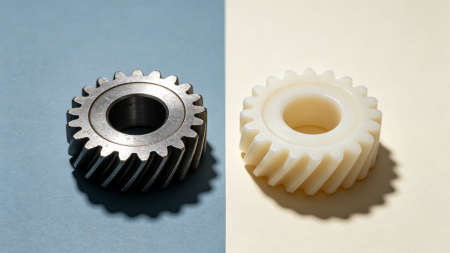
1. Background and Equipment Issues
The high-speed packaging machines serve the food, daily chemical, and related industries. Key drive mechanisms include conveying, indexing, synchronous drives, and winding and positioning. The original design used 40Cr quenched and tempered steel or 45 steel gears. As speeds increased, four problems appeared.
1.1 Increased Noise at High Speeds
Metal gears have high rigidity and low damping. They are sensitive to tooth profile errors, mounting deviations, and meshing impacts. This produces noticeable vibration and noise at high speeds.
1.2 Frequent Lubrication Maintenance
Metal gears need oil or grease to control friction and wear. In compact drive positions with limited lubrication access, regular relubrication adds to the maintenance workload.
1.3 High Inertia in Fast-Moving Parts
Steel is dense. In high-speed start-stop and reciprocating mechanisms, heavy gears increase rotational inertia. The drive system must handle higher acceleration and deceleration loads.
1.4 Maintenance Pressure on Small High-Speed Gears
Small metal gears at high speed face frequent tooth contact and limited lubrication. Over time, wear develops, requiring inspection or replacement.
2. Root Cause Analysis
2.1 Mismatch Between Material and Operating Conditions
Metal gears deliver high strength, temperature resistance, and load capacity. They suit heavy-duty, high-torque applications. But for high-speed, low-to-medium load automation, these strengths are not fully used. High density and low damping become disadvantages. The issue is not insufficient strength—it is a material mismatch.
2.2 High Rigidity Transmits Vibration
Steel has a high modulus of elasticity. Meshing impact energy is not absorbed. It travels through shafts, bearings, and the housing. Engineering plastics offer far better damping. They absorb vibration energy and reduce noise.
2.3 High Density Increases Inertia
| Material | Density (approx.) |
| 40Cr steel | 7.8 g/cm³ |
| [Cast nylon (PA6G)] | 1.15–1.20 g/cm³ |
For the same dimensions, a nylon gear is significantly lighter. In reciprocating mechanisms, this directly lowers rotational inertia and improves dynamic response.
3. Solution
3.1 Replace Selected Metal Gears with Cast Nylon (PA6G) Gears
After evaluating working conditions, some low-to-medium load gears, driven gears, and idler gears were replaced with cast nylon gears.
Material selected: [Cast nylon (PA6G)]
Reinforced or modified grades are available depending on requirements.
Selection criteria checked:

Gear load capacity
Speed requirements
Operating temperature
Ambient humidity
Expected service life
Cast nylon gears vs. metal gears:
Lower density, lighter weight
Lower coefficient of friction
Inherent self-lubricating properties
Better vibration damping
Reduced operating noise
3.2 Optimize Tooth Profile and Installation Design
Nylon behaves differently from metal. The design must account for material-specific properties.
Key design optimizations:
Set appropriate backlash
Allow for dimensional changes from moisture absorption
Optimize root fillet radius
Reduce meshing impact
During installation, control axial runout, radial runout, and fit clearances. This ensures stable operation.
3.3 Adjust the Lubrication Approach
Metal gears depend on regular lubrication. Nylon gears can reduce lubrication needs in certain low-load applications.
Lubrication strategy by environment:
Some applications: initial lubrication only
Enclosed drives: extended relubrication intervals
The final lubrication plan should still be based on speed, load, and temperature conditions.
4. Results
After the material change and design optimization:
Lower operating noise – Damping properties reduce meshing impact. High-speed running is quieter and smoother.
Reduced maintenance – Improved friction characteristics lower lubrication frequency and daily maintenance work.
Better motion response – Lighter gears decrease rotational inertia in high-speed start-stop mechanisms. Equipment responds faster.
Improved running stability – The elasticity of nylon gears cushions drive shocks. Overall transmission behavior is smoother.
5. Key Engineering Takeaways
Gear material selection is not about choosing the highest strength. It is about matching the material to real operating conditions.
A well-designed [nylon gear] (such as cast nylon PA6G) provides a cost-effective option for automated equipment with medium-to-low loads, high-speed operation, noise sensitivity, and a need for reduced maintenance.
Metal gears remain the preferred choice for high-torque drives, elevated temperature environments, and severe impact loads.
The right decision evaluates load, speed, temperature, and operating environment as a whole—not just raw material strength.
Related Products
Learn more about the cast nylon (PA6G) materials used in this application:
[PA6G Solid Rods & Tubes for Gear Blanks]
[Custom Nylon Gear Machining Service]
