Product Overview
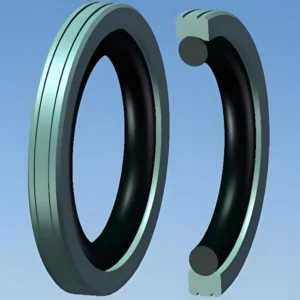
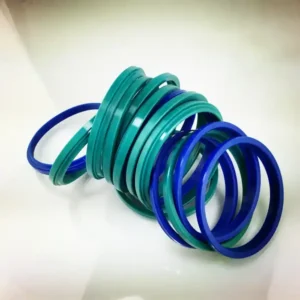
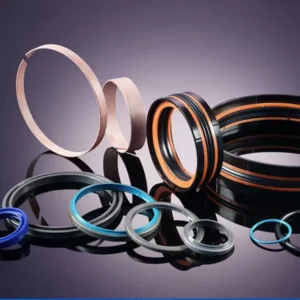
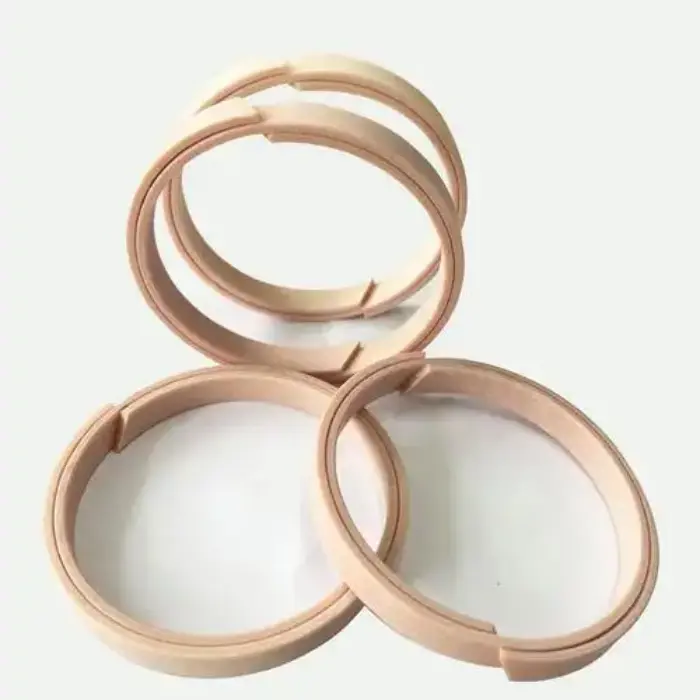
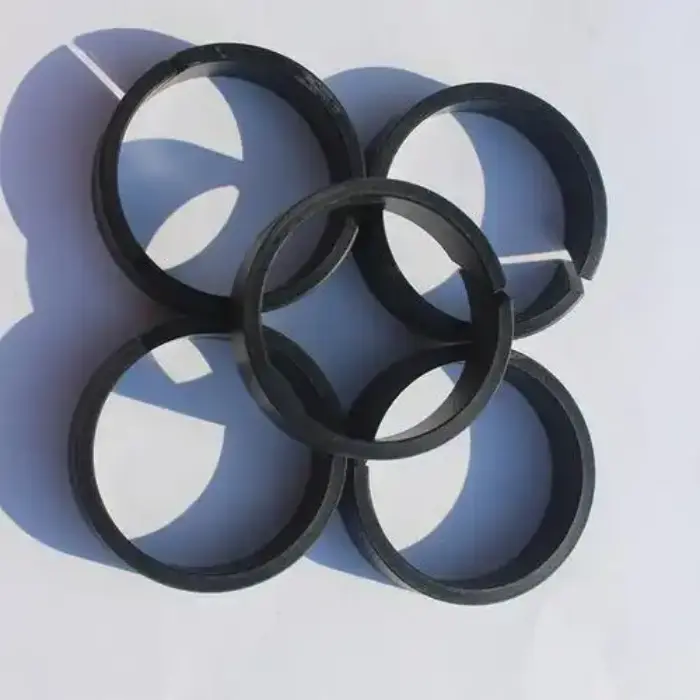
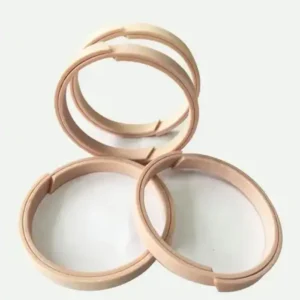
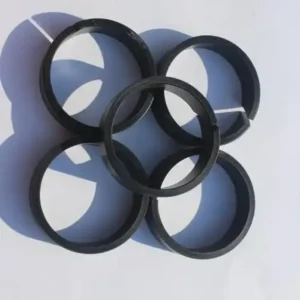
Hydraulic guide rings are non-sealing bearing elements installed in piston or rod gland grooves to guide reciprocating parts, absorb transverse loads and prevent direct metal contact with the cylinder housing. Proper guide selection reduces side load on seals and bearings, minimizes scoring, and improves service life in mobile and industrial hydraulics. Common product aliases used by procurement: wear ring, piston guide, guide strip, bearing element, and rod/piston guide.
Key Purchasing Features
-
Controlled radial clearance to prevent metal-to-metal contact and protect seals.
-
Material options: PTFE, bronze-filled PTFE, POM (nylon), phenolic — matched to load, speed and media.
-
Stocked metric & imperial sizes for fast replacement; custom machining and tooling for OEM volumes.
-
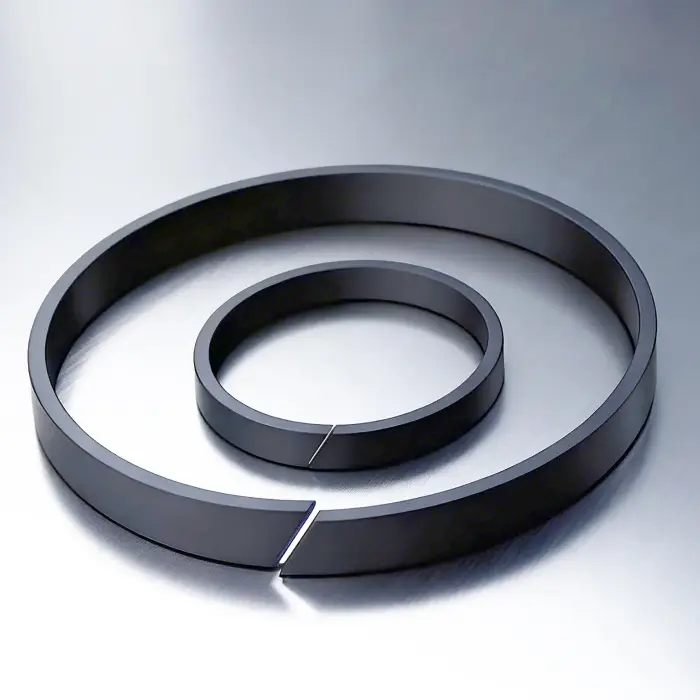
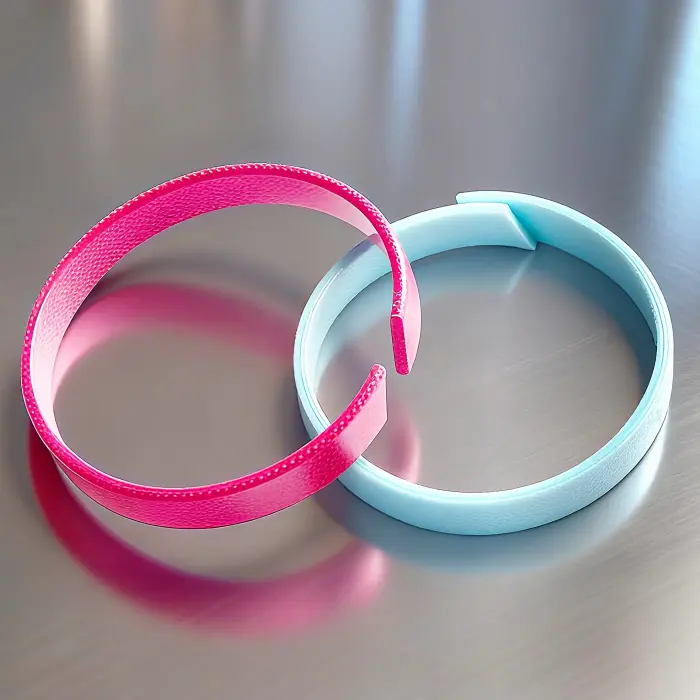
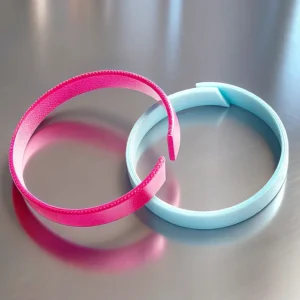
Available as full rings, cut rings (butt/angle gap), strips and bonded flange types for different gland geometries.
Detailed Description & Procurement Guidance
Guide rings are a low-complexity, high-impact component for hydraulic reliability. Selection requires three inputs: (1) operating environment (temperature, media, contamination), (2) mechanical demands (side load, speed, stroke), and (3) cylinder dimensions (piston/rod diameter, groove width). We provide part selection support: send cylinder drawings or sample parts and our engineers will match the appropriate profile, recommend radial clearance and confirm material grade for the expected lifetime. Our standard approach follows industry gland/guidance tables and tolerance practices to avoid premature failure.
Materials & Typical Performance
Material guide (selection summary):
-
PTFE (unfilled): very low friction, excellent chemical compatibility, suitable for medium loads and where stick-slip must be minimized.
-
Bronze-filled PTFE (e.g., 25–40% bronze): enhanced load capacity and wear resistance while retaining low friction — ideal for high load/long stroke applications.
-
POM / Nylon (polyacetal): good wear resistance and inexpensive option for moderate loads and clean hydraulic systems.
-
Phenolic (laminate): used where high stiffness and dimensional stability are required at higher temperatures.
Engineering note: our material recommendations consider operating temperature, fluid compatibility and particulate exposure — we supply the chosen grade with batch traceability and hardness/compound data on request.
Design and tolerance facts: precision machining and tight tolerances (down to ±0.001″ on critical diameters) are common for high-performance wear rings; proper tolerance control prevents metal-to-metal contact under deflection.
Technical Specifications & Recommendations
Functional Ranges
-
Operating temperature (typical by material):
PTFE: −200°C to +260°C (material dependent); Bronze-filled PTFE: similar but check filler limits; POM: −40°C to +100°C; Phenolic: up to ~150°C depending on resin. -
Radial clearance (recommended range): 0.05 mm to 0.25 mm (0.002″–0.010″) depending on cross-section thickness and material; tight tolerance guide rings may limit clearance to prevent deflection-induced contact.
-
Typical cross-section thickness (stock): 2.5 mm, 3 mm, 4 mm, 5 mm, 6 mm, 8 mm, 10 mm (custom thickness available).
-
Typical part tolerances: OD/ID tolerances as tight as ±0.03 mm (±0.001″) for precision hydraulic applications; surface finish and concentricity affect wear life.
(Provide cylinder bore/rod/piston drawings for final quote so we can confirm exact groove geometry and tolerances.)
Standard Stock Sizes
We maintain inventory across common metric and imperial diameters—examples below represent stocked ranges (please confirm exact OD/ID with part code):
Metric rod/piston diameters (mm): 6, 8, 10, 12, 16, 20, 25, 32, 40, 50, 63, 80, 100.
Imperial diameters (in): 1/4″, 3/8″, 1/2″, 5/8″, 3/4″, 1″, 1¼”, 1½”, 2″.
Representative dimension table
| Piston/Rod Ø | Typical Cross-Section | Typical OD Range | Typical Width (axial) |
|---|---|---|---|
| 10 mm | 3.0 mm | 16–18 mm | 2.5–4.0 mm |
| 25 mm | 4.0 mm | 32–34 mm | 3.5–5.0 mm |
| 40 mm | 5.0 mm | 50–52 mm | 4.0–6.0 mm |
| 63 mm | 6.0–8.0 mm | 75–78 mm | 5.0–8.0 mm |
Advantages — Why purchase our guide rings
-
Experience: supply history across construction, agricultural, mobile hydraulics and industrial OEMs.
-
Engineering support: free material and groove-fit consultation for RFQs; CAD verification on request.
-
Quality & traceability: batch IDs, incoming material certificates and dimensional inspection reports supplied with shipments.
-
Lead time flexibility: stocked common sizes for immediate shipment; competitive lead times on custom-machined and bronze-filled PTFE runs.
-
Differentiator: optional micro-textured PTFE surfaces (embossed guide strips) to promote micro-lubrication and trap abrasive particles, improving seal life in contaminated environments.
Material Comparison Table
| Property / Material | PTFE (unfilled) | Bronze-filled PTFE | POM / Nylon | Phenolic |
|---|---|---|---|---|
| Abrasion resistance | Good | Very Good | Good | Good |
| Load capacity | Medium | High | Medium | High |
| Friction coefficient | Low | Low | Medium | Medium |
| Temperature range | Very wide | Very wide | Moderate | High |
| Typical use case | Low friction / chemical | High load / long life | Cost-sensitive, clean | High stiffness, high temp |
Applications
-
Construction and mobile equipment (excavator, loader, telescopic booms)
-
Agricultural hydraulics (cylinders on harvesters, trailers)
-
Industrial presses and injection molding machines
-
Marine and offshore hydraulics (choose corrosion-resistant materials)
-
High-speed or high-load cylinders in material handling and robotics
Installation & Maintenance Guidance
-
Measure piston/rod diameter, housing bore and groove width; send photos or drawings for a fast-match quote.
-
Recommended rod/piston surface finish: Ra ≤ 0.4 μm for best wear performance; plating or nitriding preferred in abrasive environments.
-
Replace guide rings when excessive runout, cracking or wear is observed—typically at the same interval as rod seals.
-
Use bronze-filled PTFE for heavy side-load and abrasive conditions; use unfilled PTFE where friction must be minimized.
FAQ
Q1: Are guide rings the same as seals?
A: No. Guide rings (wear rings) are non-sealing bearing elements that guide and support; seals (rod/piston seals) retain fluid under pressure. Both are complementary.
Q2: How tight should the radial clearance be?
A: Typical clearance ranges from 0.05 mm to 0.25 mm (0.002″–0.010″) depending on ring thickness and material; for tight-tolerance rings used in precision hydraulics clearance is minimized per manufacturer tables. Provide your cylinder data and we will recommend exact clearance.
Q3: Do you supply sample rings for fit checks?
A: Yes — sample policy available on request; samples may be refundable with subsequent bulk order.
Q4: Can you match legacy or OEM profiles?
A: Yes — we can reverse-engineer from samples or drawings and offer custom tooling for OEM runs.
Q5: What lead times should I expect?
A: Stock items: typically 3–7 business days (depending on quantity). Custom bronze-filled PTFE or special tooling: typically several weeks — final lead time confirmed at RFQ.
Product Catalog & Downloadable Specs
Downloadable files (placeholders — host on your domain):
(If you prefer, we will produce branded, print-ready PDFs with your logo and product codes — provide logo and exact contact details.)
Experience • Expertise • Authoritativeness • Trustworthiness
Our sealing and guidance product team has extensive, hands-on experience specifying guide rings for OEM and aftermarket cylinder programs. We apply industry design tables, manufacturing tolerances and material science to every quote. Material certificates and dimensional inspection reports accompany larger orders to support procurement and maintenance traceability.
Ordering, Samples & Terms
-
How to order: Submit RFQ with cylinder drawings, rod/piston Ø, groove width and preferred material. For legacy parts send a sample or part drawing.
-
MOQ: stocked items: small quantities; custom tooling: MOQ applies and varies by profile.
-
Sample policy: sample units or small packs available for fit verification; costs may be credited to first bulk order.
Contact & Company Information
Hengshui Aohong— Mechanical Seals Division
-
Email: sales@aohongglobal.com (for datasheet requests and fast quotes)
-
Phone: +(86) 153 7318 1024 (please replace with your official number)