
Picking the wrong packing stops a pump in hours. Get it right and the seal runs for months with nothing more than a quarter-turn adjustment now and then. This guide walks through the materials that actually matter, what they handle, and where they fail, so you can buy with confidence—whether you are stocking a warehouse or specifying for a single critical machine.
Key Factors That Drive Packing Choice
Before looking at material names, pin down what the packing will face. These five points rule out most options right away.
Temperature at the stuffing box. Not the process temperature somewhere else in the line. The heat right where the shaft meets the packing.
Pressure in the box. Pump discharge pressure matters less than the pressure the packing sees. High pressure needs anti-extrusion rings.
Chemical makeup of the fluid. pH alone isn’t enough. A dilute acid at room temperature and a hot concentrated acid behave very differently on the same fiber.
Shaft speed for rotary equipment. Expressed in meters per second or feet per minute. A material that works beautifully in a slow mixer can burn up on a 3600 rpm pump.
Equipment type. A valve stem moves axially with long idle periods. A reciprocating rod cycles back and forth at high frequency. A centrifugal pump shaft spins continuously. Each one loads the packing differently.
One more thing worth checking: whether the box has a lantern ring with a flush line. A clean external flush can extend the life of packing that would otherwise clog or overheat.
 Packing Material by Material
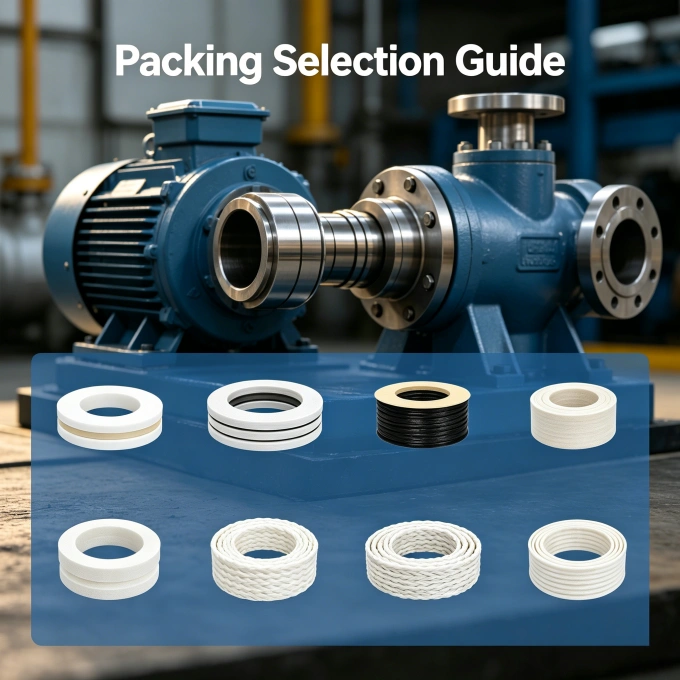 Packing Material by Material
PTFE Packing
PTFE stands up to nearly the entire pH range. Acids, caustics, solvents—it shrugs them off. The temperature ceiling sits around 260 °C. Friction is low, so shafts wear less.
This is the first choice for food processing, pharmaceutical lines, and any chemical service where contamination cannot happen. The catch is thermal conductivity. PTFE does not pull heat away from the shaft well, so at higher speeds you need a flush or you risk burning the packing from the inside out. Graphite-filled PTFE variants improve heat transfer somewhat.
Aramid Packing (Kevlar)
Aramid fiber is tough and abrasion-resistant. It handles slurries, pulp stock, wastewater, and gritty fluids that would chew through softer materials. Impregnations of PTFE and graphite add lubrication and chemical resistance.
Temperature typically maxes around 250 °C in steam, lower in dry running. A word of caution: aramid can score a shaft sleeve if the gland is overtightened. Accurate installation matters more here than with softer packings. Not the best choice for strong acids or strong alkalis.
Graphite Packing
Flexible graphite packing runs where it gets hot. In steam service it holds to 450 °C and beyond in reducing or inert atmospheres. Thermal conductivity is excellent—it carries heat away from the shaft, which prevents hot spots.
Power plants, boiler feed pumps, and high-temperature valves rely on graphite. Do not use it with strong oxidizing agents like nitric acid or concentrated sulfuric acid. Graphite also conducts electricity, so avoid it where galvanic corrosion is a risk.
Carbon Fiber Packing
Carbon fiber shares graphite’s thermal talent but brings higher tensile strength. It handles high shaft speeds, hot water, and aggressive chemicals. Boiler feed pumps and hot oil services run carbon fiber packing successfully at temperatures up to 400 °C in some formulations.
The price is higher than most other options, but in extreme duty the longer run time justifies it. Ensure the fiber is fully graphitized if the application approaches the upper temperature limit.
Ramie Packing
Ramie is a natural fiber. It swells when wet, which helps seal low-pressure water lines. Cold water, irrigation pumps, and marine tail shafts still use ramie because it costs very little. Temperature stays below 100 °C. Not for oil, not for solvents, not for anything that dries out the fiber. A basic material for basic jobs.
Phenolic Packing
Phenolic fiber packing is often impregnated with lubricants and graphite. It resists flame and char rather than melting, which makes it useful in fire-safe valve applications and certain boiler mountings. Temperature range typically up to 260 °C. It works with water, mild chemicals, and saturated steam. The fiber itself is somewhat brittle compared to synthetics, so it benefits from careful handling during cut and install.
Asbestos Packing
Asbestos packing was once standard in steam and chemical lines. It held temperature to around 300 °C and handled a wide pH range. It also causes serious health damage.
Today, almost every jurisdiction restricts or bans asbestos in new installations. Modern substitutes—graphite, PTFE, aramid—match or exceed its performance without the risk. If a specification still calls for asbestos, push back. There is a safer, legal replacement that fits the same stuffing box.
Acrylic Fiber Packing
Acrylic fiber packing sits in the general-purpose bracket. It handles cool water, oils, and mild chemicals up to about 150 °C. The fiber is soft and beds in quickly, which makes installation forgiving. It’s an economical pick for low-demand centrifugal pumps, washdown systems, and similar light duty. Not suitable for high pressure or aggressive media.
Quick Selection Table
Use the table below to narrow the field. The values are general maximums—always check the specific manufacturer’s data sheet for the grade you are buying.
| Material | Max. Temp | Max. Pressure | pH Range | Shaft Speed | Best For | Not Recommended For |
|---|---|---|---|---|---|---|
| PTFE | 260 °C | 50 bar | 0–14 | Low to medium | Corrosive chemicals, food, pharma | High speed without flush |
| Aramid (Kevlar) | 250 °C | 50 bar | 3–11 | Medium | Slurries, wastewater, abrasive fluids | Strong acids/alkalis |
| Graphite | 450 °C (steam) | 100 bar | 0–14* | High | Steam, boiler feed, high-temp valves | Oxidizing agents (HNO₃) |
| Carbon Fiber | 400 °C | 80 bar | 0–14 | High | High-speed pumps, hot oil, boiler feed | High cost for simple jobs |
| Ramie | 100 °C | 10 bar | 6–8 | Low | Cold water, irrigation, tail shafts | Oil, solvents |
| Phenolic | 260 °C | 40 bar | 4–10 | Low to medium | Fire-safe valves, steam, general use | Highly corrosive chemicals |
| Asbestos | 300 °C | 50 bar | 2–12 | Medium | (Legacy only – replace) | Any new installation |
| Acrylic Fiber | 150 °C | 20 bar | 5–9 | Low to medium | Cool water, light oil, general purpose | High temperature, aggressive media |
*Graphite pH range excludes strong oxidizers.
Matching Packing to the Machine
Centrifugal Pumps
The main packing workhorse in most plants. For clean cold water, acrylic or ramie often does the job. Add chemicals and move to PTFE. Hot water or boiler feed shifts the call to graphite or carbon fiber. If the pumped fluid carries grit, aramid becomes the pick, but only if shaft speed stays within its range.
Valves
Valve stem packing spends long periods static, then moves. This can cause packing to stick and then leak when operated. Graphite and PTFE dominate here. Graphite handles high-temperature steam and thermal cycling. PTFE suits chemical and sanitary valves. For fire-safe designs, graphite and phenolic are common. Always stagger the cuts and use a hard top and bottom ring if the pressure exceeds 40 bar.
Reciprocating Rods and Mixers
The back-and-forth motion pulls packing out of shape fast if the material choice is wrong. Aramid and carbon fiber stand up to the abrasion. Anti-extrusion rings at both ends of the set are often mandatory. PTFE can work for short strokes and clean fluids but may cold-flow under heavy load.
Agitators and Slow Rotating Shafts
Shaft runout and misalignment matter more at low speeds because the packing has less chance to self-center. Soft packings like acrylic and PTFE adapt better. If the process runs hot, flexible graphite takes over. Check the stuffing box condition carefully—worn boxes on old mixers ruin new packing quickly.
Mistakes Buyers Make
Buying on price alone. A cheap acrylic set in a hot water pump fails fast and costs more in downtime than the graphite rings that would have run for a year.
Ignoring shaft speed. The temperature limit on a data sheet means nothing if shaft speed pushes frictional heat past it. Always cross-check both.
Over-specifying material. A carbon fiber set in a cold water transfer pump is a waste of money. Save the high-end stuff for where it’s actually needed.
Reusing old packing dimensions without measuring. A rebuilt shaft or a replaced sleeve may sit at a different diameter. Measure every time.
Skipping the flush plan. A clean external flush can drop the stuffing box temperature by 30–40 °C and double packing life. Invest in the lantern ring and the flush line.
A Word on Standards
Look for packing that meets ASTM F2163 for braided compression packing or relevant DIN and BS standards. For potable water, confirm WRAS or NSF 61 compliance. For food contact, FDA-listed PTFE grades are required. Don’t leave compliance to guesswork—ask for the paperwork.
If the job sits at the edge of two material choices, send the full operating data—fluid, temperature, pressure, shaft speed, and box dimensions—to a packing engineer before quoting. A ten-minute check beats a box of returned product.
