
Product Overview
Face seals (also called face-type seals, axial face seals, seal faces or face gaskets) are axial sealing elements that create a pressure-tight barrier on flat or mating faces. Available as mechanical face seals (mating rotating/static faces), PTFE-lined face seals, elastomeric O-ring energized face seals and metal-jacketed face gaskets, our face seals are engineered for reliable leak control in pumps, valves, compressors, mixers and heat exchangers. Designed for quick OEM integration or retrofit repair, these face seals reduce downtime and simplify installation for B2B procurement.
A face seal is an axial sealing solution that seals between two flat (or axially loaded) surfaces rather than around a shaft circumference. Typical types include:
-
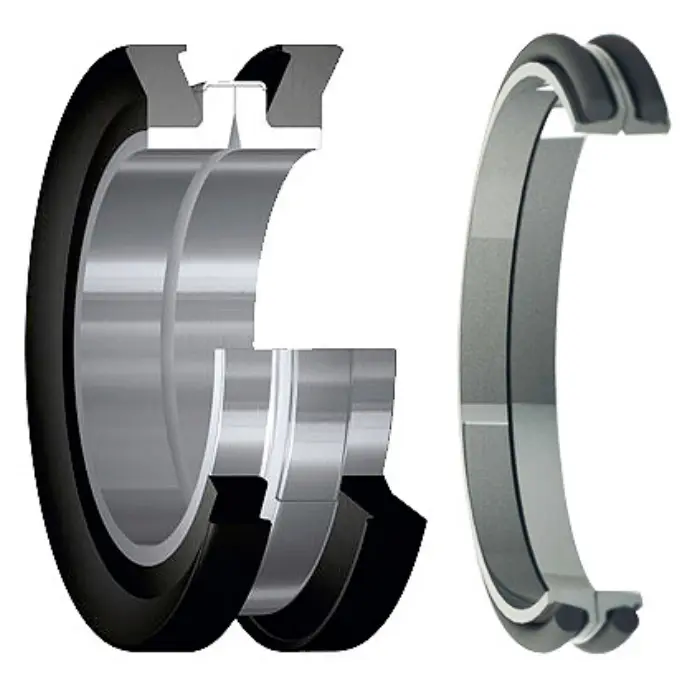
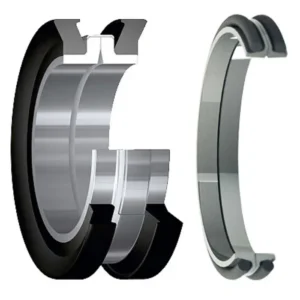
Mechanical face seals — paired, flat or conical faces (carbon vs ceramic, carbon vs silicon carbide) that seal under axial load for rotary equipment.
-
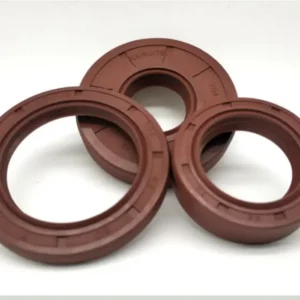
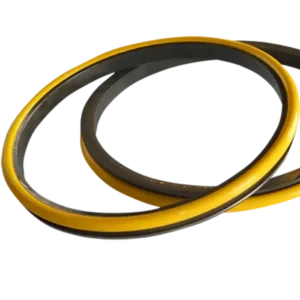
Elastomeric (O-ring energized) face seals — elastomer body with a sealing lip or face pressed against a mating surface.
-
PTFE-lined face seals — chemical-resistant low-friction face for aggressive media.
-
Metal-jacketed / spiral wound face gaskets — for flanged joint sealing at higher pressures and temperatures.
Common aliases: face-type seal, axial face seal, seal face, face gasket, mechanical seal face.
Key Applications
-
API and non-API pumps (mechanical face seals for shaft sealing)
-
Valve bonnet and flange sealing (face gaskets and O-ring energized face seals)
-
Compressors and mixers (rotary face seals)
-
Heat exchangers and plate assemblies (flat face seals)
-
Chemical processing, food & beverage, marine, power generation and OEM machinery
Technical Specifications
All values are typical industrial ranges. Final selection must consider fluid compatibility, temperature, pressure, surface finish and shaft speed. Contact our engineering team for validated performance data and CAD support.
| Parameter | Value / Range |
|---|---|
| Seal types | Mechanical face seal, O-ring energized face seal, PTFE-lined face seal, metal-jacketed face gasket |
| Materials — face / seat | Carbon graphite, silicon carbide (SiC), ceramic (alumina), stainless steel (304/316), PTFE, filled PTFE, metal (Monel, Inconel) |
| Materials — elastomer | NBR (Nitrile): -40°C to 100°C; FKM (Viton): -20°C to 200°C; EPDM: -50°C to 150°C |
| Temperature range | Elastomeric: -40°C … 200°C (material dependent); PTFE: -200°C … 260°C; Graphite/metal: up to 450°C (design dependent) |
| Pressure rating (typical) | Elastomeric face seals: up to ~20–40 bar; PTFE-lined face seals: up to ~80–120 bar; Metal-jacket/RTJ style: high pressure (design dependent). Mechanical face seals: application dependent, commonly up to 40–100 bar in industrial pumps. |
| Shaft speed (mechanical face seals) | Up to 20 m/s typical for sealed faces (depends on face materials, lubrication and design) |
| Surface finish (mating faces) | Ra 0.4–1.6 μm recommended for most PTFE and elastomer face seals; mechanical mating faces require controlled lapping and flatness ≤0.01 mm for high-performance applications |
| Typical tolerances | ID/OD tolerances per ISO/ASME standards; flatness and parallelism ≤0.01–0.05 mm depending on service |
| Wall / thickness (flat seals) | 0.5 mm – 6.0 mm common; custom thickness by request |
| Typical SKU lead time | Stock sizes: 3–7 business days; Custom materials or faces: 2–6 weeks (qty dependent) |
Standard Sizes & Formats
We stock both standard and OEM face seal profiles. Below are common ranges; exact part sizing should follow your flange/shaft drawing.
Flat face / flange seals (ID × OD × thickness) — metric examples:
-
10 × 20 × 2 mm, 25 × 40 × 2.5 mm, 40 × 60 × 3 mm, 80 × 100 × 3 mm, 150 × 170 × 4 mm, 300 × 320 × 5 mm
(available up to 2000 mm OD; custom shapes and bolt hole patterns on request)
Mechanical rotary face seals (shaft ID ranges / face diameters)
-
Shaft sizes: 6 mm → 200 mm (standard stocked range); larger diameters available as custom assemblies.
Common face pair diameters: 12 mm, 20 mm, 30 mm, 40 mm, 50 mm, 75 mm, 100 mm, 150 mm
Elastomer-energized face seals — available in standard AS568/O-ring cross sections or custom profiles for flange bores.
Configuration options: single face, tandem face (dual faces), balanced/unbalanced mechanical face seals, split face rings for retrofit, PTFE lip with metal backup, metal-jacketed with filler (graphite or PTFE).
Product Variants & Detailed Descriptions
Mechanical Face Seals
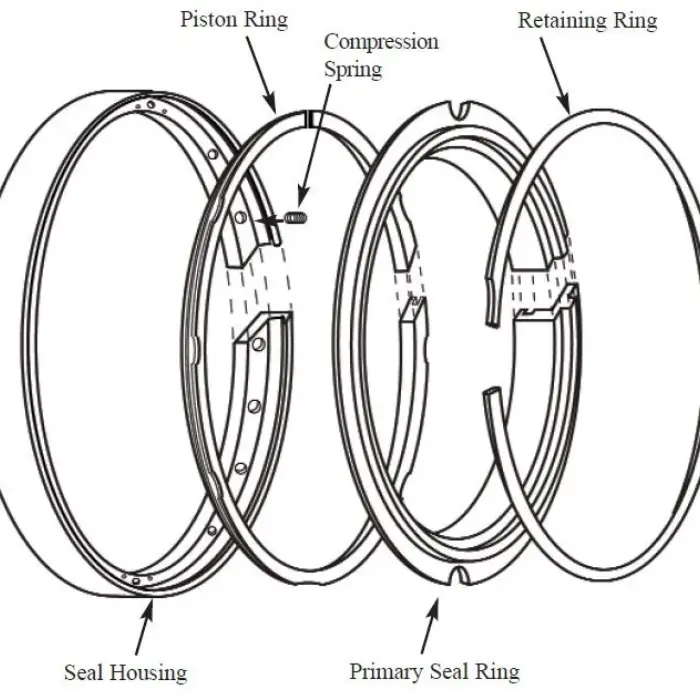
Precision lapped mating faces (carbon vs SiC, ceramic vs SiC) with an elastomer energizer or metal spring assembly. Designed for pumps, compressors and mixers. Use when fluid leakage control at rotating shafts is required under pressure and axial loading.
Benefits: low leakage, repeatable performance, replaceable face cartridges, engineered face material pairing for longevity.
Elastomeric (O-ring Energized) Face Seals
A flat sealing face backed by an elastomer energizer or O-ring. Ideal for flange faces, valve stems and low-speed rotary applications.
Benefits: simple installation, excellent sealing on imperfect faces, lower cost, good for moderate pressures.
PTFE-Lined Face Seals
PTFE or filled-PTFE facing on metallic backing provides chemical resistance and low friction. Suited for aggressive chemicals, solvents and slurry services.
Benefits: excellent chemical compatibility, low breakaway torque, long service life in caustic environments.
Metal-Jacketed & Spiral-Wound Face Gaskets
For high-pressure flanged joints and elevated temperature services. Available with graphite, flexible graphite or PTFE filler.
Benefits: reliable high-pressure seal, good for thermal cycling and creep resistance.
Advantages
-
Leak-tight performance engineered for critical rotating and static applications.
-
Rapid retrofit & OEM integration — cartridge-style mechanical faces and split rings minimize downtime.
-
Material breadth — carbon, SiC, ceramic, PTFE, stainless and high-performance alloys for exact service matching.
-
Custom engineering support — CAD, drawing review, lifecycle testing and field-fit kits for complex installations.
-
ISO-quality manufacturing — dimensional inspections, lapping records and batch traceability available.
-
Scalable supply — small pilot runs to high-volume OEM production with consistent tolerances.
Comparison: Face Seal Materials & Typical Service Window
| Characteristic | Elastomer (NBR/FKM) | PTFE / Filled PTFE | Carbon / Graphite Faces | Silicon Carbide / Ceramic | Metal-jacketed (with filler) |
|---|---|---|---|---|---|
| Temperature | -40°C → +200°C (Viton up to ~200°C) | -200°C → +260°C | -100°C → +450°C (graphite stability) | -50°C → +600°C (material dependent) | Up to +600°C (construction dependent) |
| Pressure suitability | Low–moderate (≤20–40 bar typical) | Moderate (≤80–120 bar typical) | Moderate–high (depends on design) | High (abrasive & high-temp resistant) | High-pressure flange applications |
| Chemical resistance | Good (varies by elastomer) | Excellent | Good (chemically stable) | Excellent | Excellent (with appropriate filler) |
| Friction / wear | Moderate | Very low | Low | Very low, hard-faced | Depends on filler |
| Typical use cases | Valve/bonnet seals, flange seals | Chemical piping, low-leak rotary | Rotary faces in general service | High-speed, abrasive, high-temp faces | High-pressure flanges, thermal cycling |
Installation & Inspection
-
Verify mating face flatness and surface finish: for precision mechanical faces, ensure flatness ≤0.01 mm and Ra 0.4–1.6 μm as specified.
-
For elastomeric face seals, inspect groove dimensions and O-ring shore hardness (typical 70A for general service).
-
Use correct axial preload for mechanical faces; follow the torque and run-in procedure to seat faces gently.
-
For PTFE-lined faces, avoid dry start at high pressure—initial lubrication or slow ramp can extend life.
-
Maintain spare face sets (cartridges) onsite for rapid replacement when leakage threshold is reached.
-
Over a decade supplying face seals and sealing solutions for pump OEMs, valve manufacturers and chemical plants worldwide, with installations validated in petrochemical, marine and food sectors.
-
In-house sealing engineers provide material selection, face pairing recommendations, and CAD/CAM drawings. We perform run-time testing and life-cycle simulations for critical designs.
-
Production under ISO 9001 quality system; dimensional inspection records and run-in test certificates available on request.
-
Fast RFQ turnaround for stocked items (typically within 24–48 hours). Engineering support for custom face geometries and pilot production.
Product Catalog & Datasheet Downloads
Frequently Asked Questions
Q1: What information is required for a quick quote (RFQ)?
A1: Provide seal type (face seal / mechanical face / PTFE-lined), ID/OD/thickness or shaft diameter, face material preference, operating temperature, system pressure, fluid/chemical media, shaft speed (for rotary), required quantity and delivery location. Attach drawing or CAD if available.
Q2: Can face seals be used in steam service?
A2: Yes — select materials rated for steam temperatures (graphite, filled PTFE on metal backing, or high-temp elastomers) and verify pressure/temperature limits with engineering.
Q3: Do you offer split face rings for retrofit?
A3: Yes — split ring designs and cartridge replacements are available for in-situ replacement without shaft removal.
Q4: How long does a mechanical face seal typically last?
A4: Service life depends on operating conditions (speed, contamination, lubrication, pressure). Typical industrial lifetimes range from months to years; lifecycle testing and maintenance schedules are available to optimize replacement intervals.
Q5: Are material certificates and inspection reports provided?
A5: Yes — dimensional inspection reports come with every order. Material certificates (MTR), hardness tests and third-party inspection are available on request for critical orders.