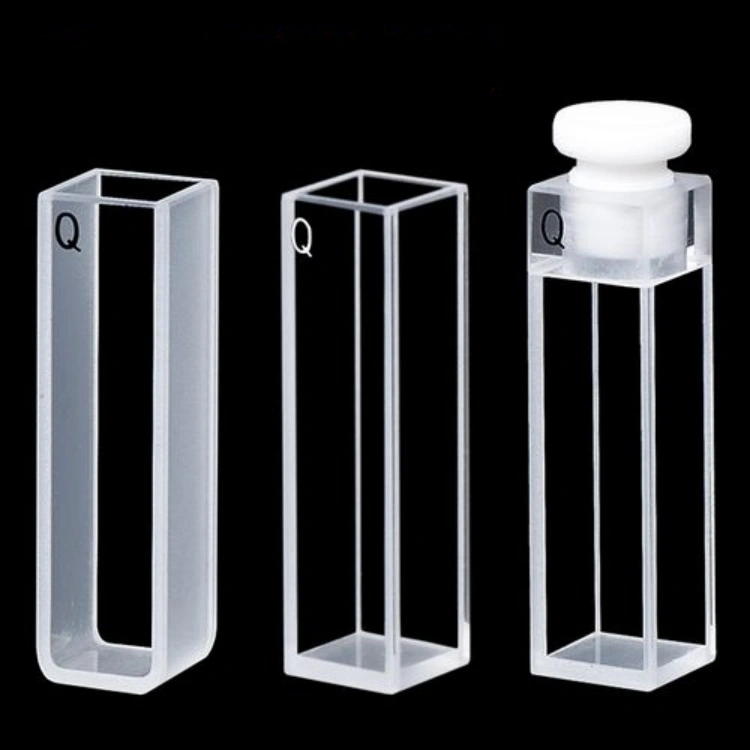
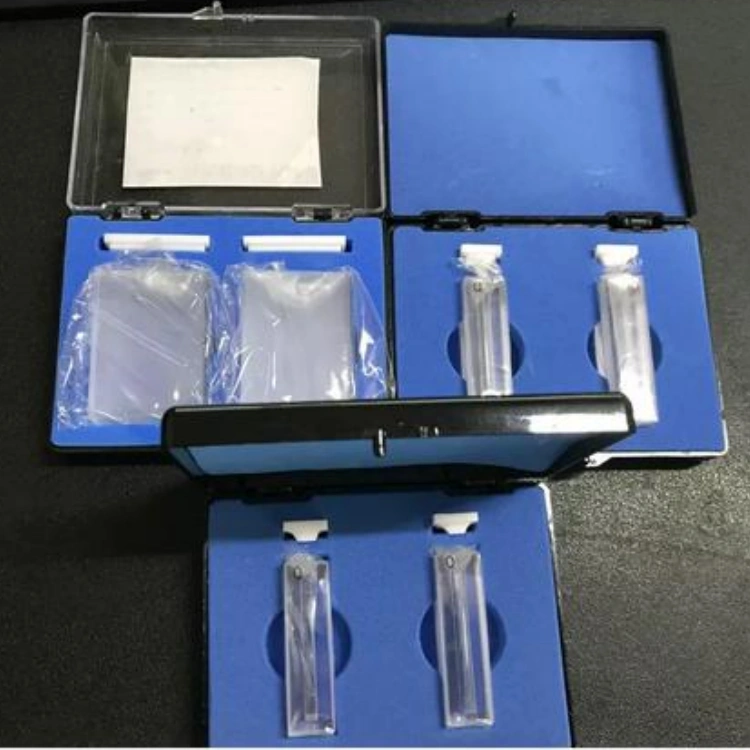
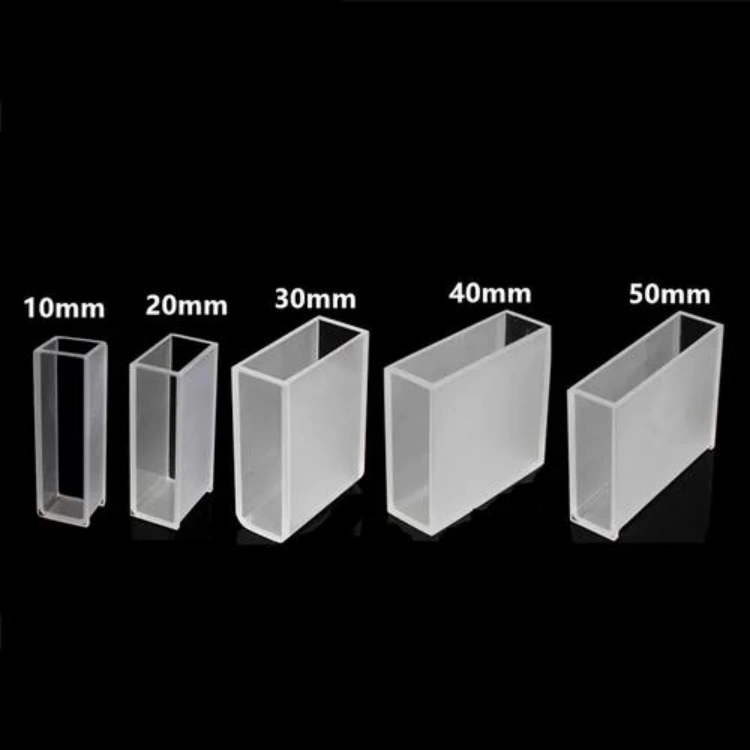
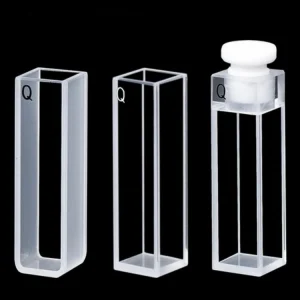
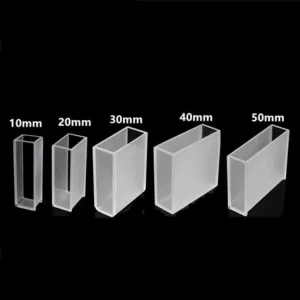
A quartz cuvette (also known as a quartz sample cell or fused silica cuvette) is a high-precision optical container designed to hold liquid samples for absorbance, transmission, and fluorescence measurements across a broad UV-Vis-NIR spectral range (190–2500 nm).
These spectrophotometer cuvettes provide exceptional transparency in the ultraviolet and near-infrared regions, ensuring accurate and reproducible analytical results in advanced research and quality control laboratories. Unlike standard glass cuvettes, quartz cells do not absorb in the critical UV spectrum, making them the gold standard for nucleic acid and protein quantification.
Key Applications & Scenarios
Ideal for demanding spectroscopic and fluorometric applications, our cuvettes are widely used across various scientific disciplines:
-
Life Sciences & Biochemistry: Essential for DNA quantification, RNA concentration analysis, protein assays, and enzyme kinetics studies.
-
Pharmaceutical Analysis: Used in drug dissolution testing, quality control, and method validation compliant with global pharmacopeia standards.
-
Environmental Science: Reliable for water quality monitoring, heavy metal analysis, and Chemical Oxygen Demand (COD) testing.
-
Clinical Chemistry & Food Safety: Suitable for routine diagnostic testing and food composition analysis.
-
Materials Science: Compatible with NIR spectroscopy and advanced optical material characterization.
Material Specifications & Design Features
-
Premium Material: Fabricated from high-purity UV-grade fused quartz (Synthetic Quartz Glass), ensuring maximum homogeneity and minimal optical interference.
-
Optical Precision: Features a standard 10 mm optical path length and 12.5 x 12.5 x 45 mm exterior dimensions to fit universal spectrophotometer holders.
-
Enhanced Durability: Constructed using a thermal-bonding process rather than adhesives. This provides superior resistance to aggressive solvents, strong acids, and bases, ensuring long-term reliability without leakage.
-
Clear Window Options: Available with either two polished optical windows (standard) or four polished windows (for fluorescence analysis).
Technical Data & Dimensions
The table below outlines the standard performance indicators for our quartz sample cells. These quartz cuvette specifications ensure compatibility and high repeatability in analytical workflows.
| Parameter | Specification |
|---|---|
| Material | High-Purity UV Fused Quartz / Silica |
| Spectral Range | 190 – 2500 nm |
| Transmission Performance | > 80% @ 200 nm (Empty Cell) |
| Standard Path Length | 10 mm (1 cm) |
| Exterior Dimensions (W x D x H) | 12.5 x 12.5 x 45 mm |
| Interior Dimensions (W x D) | 10 x 10 mm |
| Nominal Capacity | 3.5 mL |
| Matching Tolerance | ≤ 0.5% Transmission at 200 nm |
| Light Beam Height (Z-Dimension) | 8.5 mm or 15 mm (Selectable) |
| Cover Material | Chemical-Resistant PTFE (Teflon) Cover |
Common Dimensions & Volumes (Selectable)
We supply various form factors to meet specific sample volume requirements:
| Path Length (mm) | Volume (mL) | Exterior Width (mm) | Exterior Height (mm) |
|---|---|---|---|
| 1 | 0.35 | 12.5 | 45 |
| 2 | 0.70 | 12.5 | 45 |
| 5 | 1.75 | 12.5 | 45 |
| 10 (Standard) | 3.50 | 12.5 | 45 |
| 20 | 7.00 | 12.5 | 45 |
| 30 | 10.50 | 12.5 | 45 |
| 50 | 17.50 | 12.5 | 45 |
| 100 | 35.00 | 12.5 | 45 |
Data based on industry standard Type 1 UV Quartz Cuvettes (Reflex USA, 2024).
Quality Assurance & Certifications
We are committed to providing high precision quartz cuvettes that meet stringent international standards.
-
Manufacturing Standards: Our production lines comply with ISO 9001 (Quality Management) and ISO 14001 (Environmental Management) requirements, ensuring consistent quality and sustainable practices.
-
Traceability: Certificates of Conformance are available with each batch, providing assurance of path length accuracy and optical parallelism. NIST-traceable calibration options are available upon request for high-accuracy USP applications.
-
Chemical Resistance: The thermal bonding process guarantees that the cell withstands exposure to acetone, ketones, and organic solvents without degradation of the optical bond.