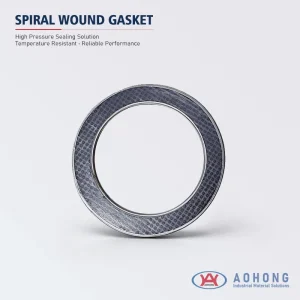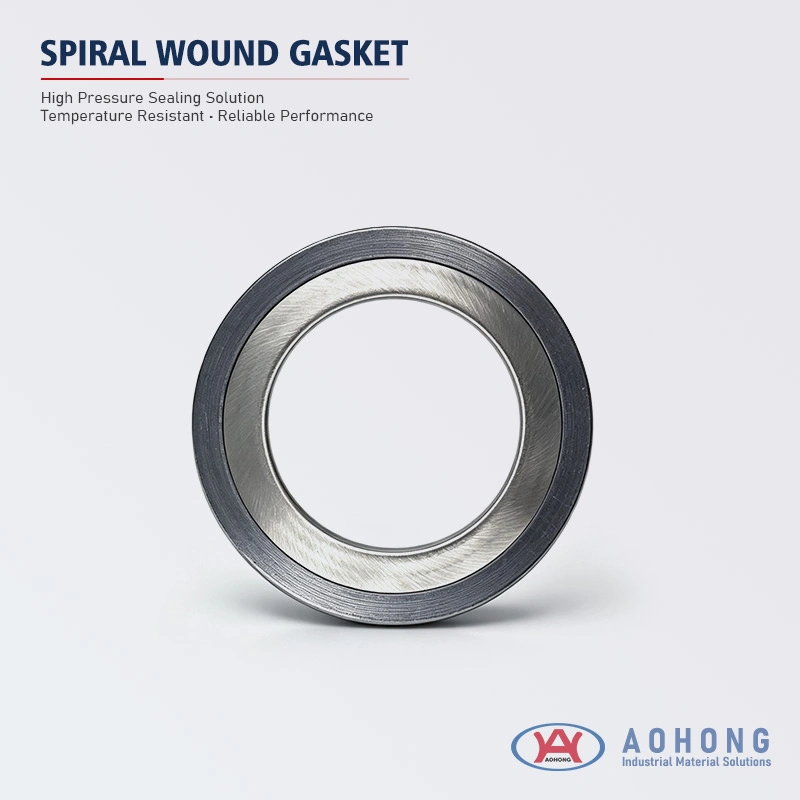
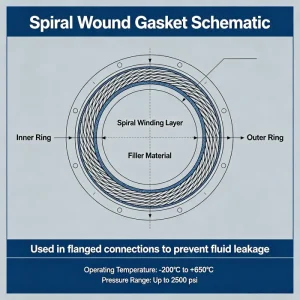
Product overview — what is a spiral wound gasket with inner ring?
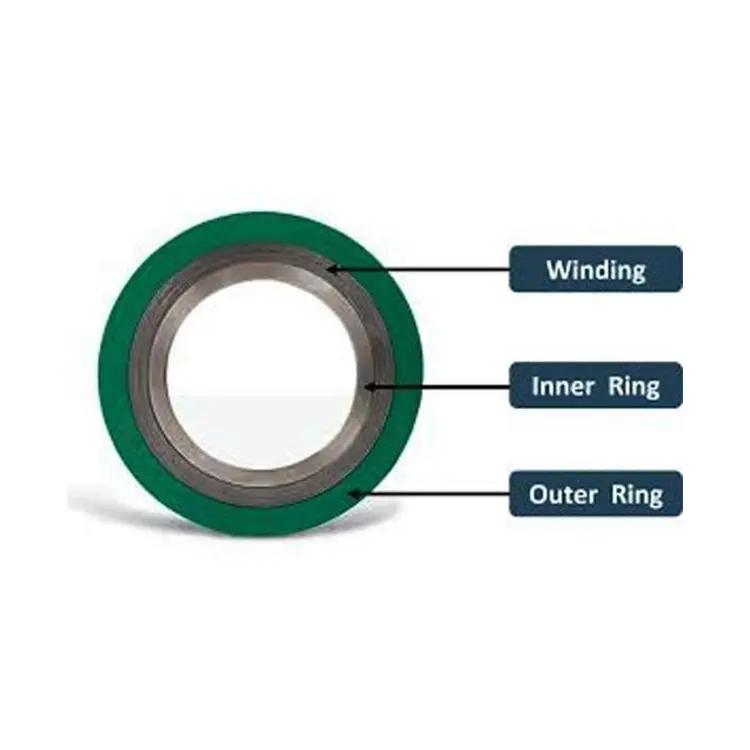
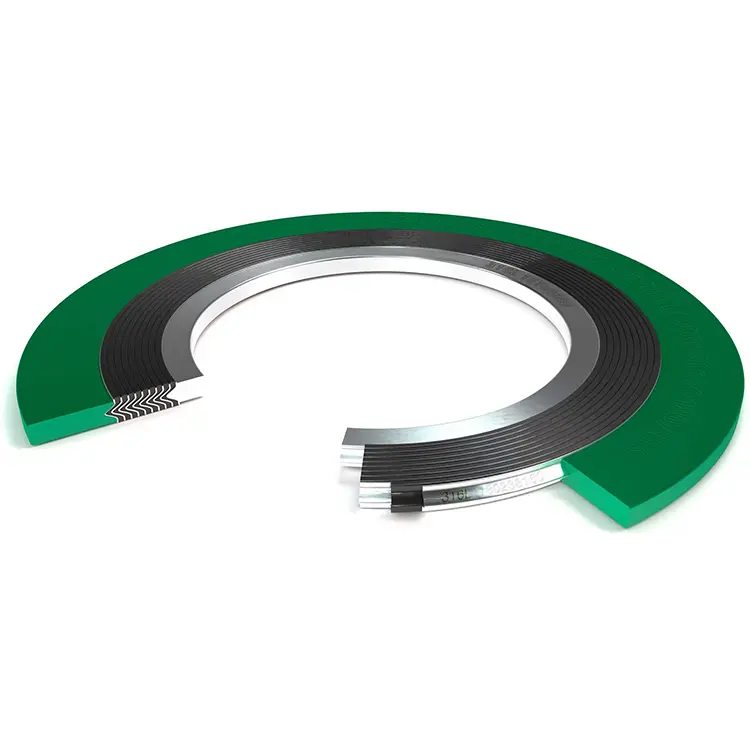
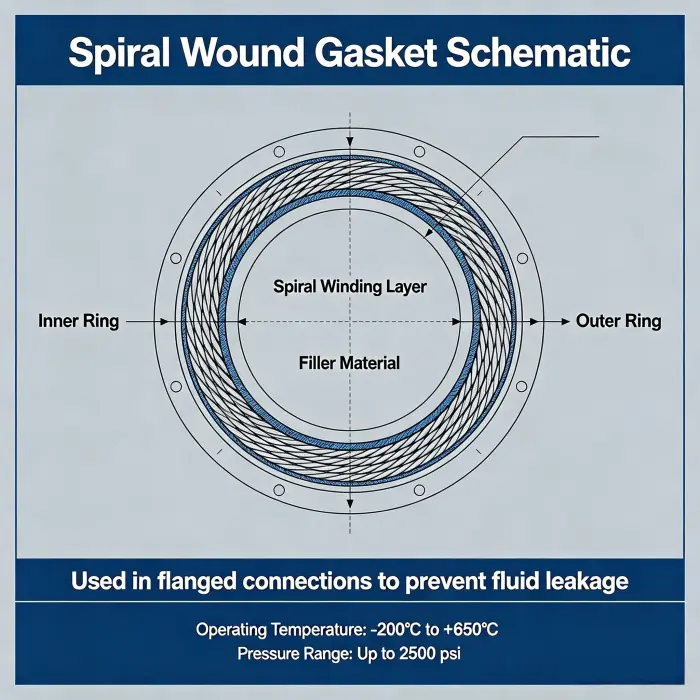
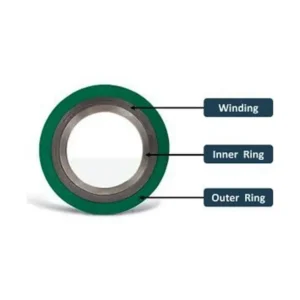
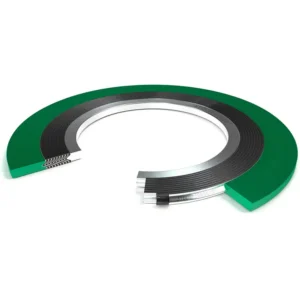
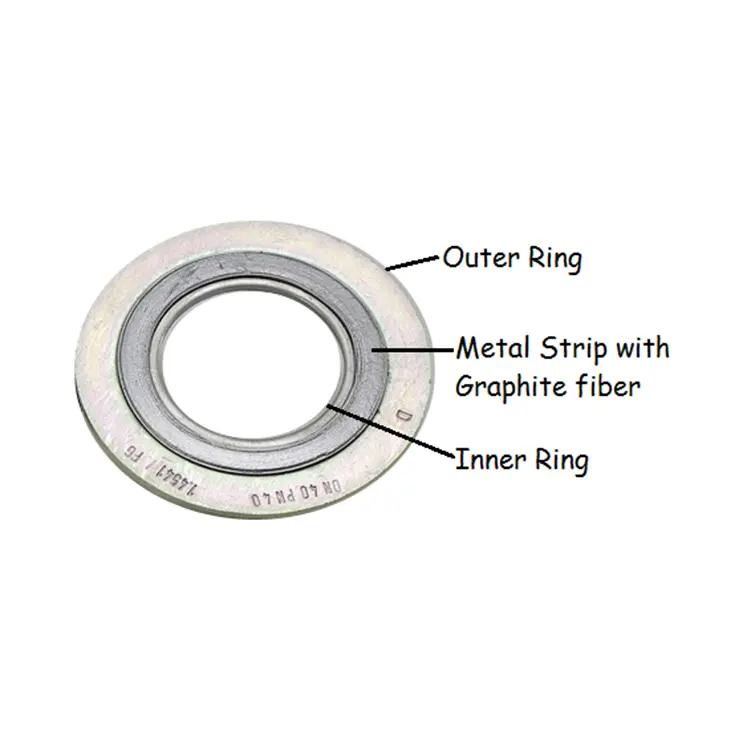
A spiral wound gasket with inner ring(SWG) is made from a helically wound metal strip (the winding) and a softer filler strip (graphite, PTFE, etc.). When supplied with an inner ring, the gasket includes a concentric metal ring along the ID that improves axial rigidity, prevents buckling into the bore, reduces turbulence and erosion, and increases blow-out resistance in high-pressure service. Common names / aliases: spiral wound gasket with inner ring, spiral-wound gasket IR, SWG with inner ring, spiral wound metal gasket (with inner ring).
A spiral wound gasket with inner ring (IR) is a semi-metallic flange seal combining a metal winding and soft filler with a concentrically fitted inner retaining ring. Inner-ring spiral wound gaskets provide blow-out resistance, protect the sealing element from erosion and turbine-action, and are the preferred choice for high-pressure/high-temperature and critical refinery, petrochemical and power applications.
Why choose the inner-ring style?
-
Prevents winding buckling and “bird’s-nest” failures in bore-flow service.
-
Increases blowout resistance and axial stiffness—critical for high-pressure flanges.
-
Shields filler from direct fluid impingement and erosion at the bore/ID.
Typical construction & materials
Winding (metal strip): 304/316/316L stainless steel, carbon steel, Monel, Inconel, or other alloys selected for corrosion and temperature resistance.
Filler (soft strip): flexible graphite (Grafoil), PTFE (virgin or filled), mica or ceramic fillers for special services. Graphite is the most common for high-temperature/steam service; PTFE is used where chemical compatibility is required.
Inner / outer rings: typically carbon steel, stainless steel or the same alloy used for windings; inner ring thickness commonly per ASME/B16.20 rules (≈2.97–3.33 mm for many sizes).
Standard manufacturing thicknesses & dimensional notes
-
Common manufacturing thicknesses (measured across the metallic strip, not filler): 3.2 mm, 4.5 mm, 6.5 mm (typical production thicknesses used by major manufacturers).
-
Inner ring thickness: industry practice often uses inner ring thickness around ~3.0 mm (ASME/B16.20 guidance and manufacturer catalogs show inner-ring thickness ranges such as 2.97–3.33 mm).
-
ASME / ANSI sizing: Spiral wound gaskets for ASME B16.5/B16.20 flanges follow standard tables for ID/OD and sealing element diameters—refer to the ASME B16.20 dimension tables for exact d1/d2/d3/d4 values per nominal flange size. (Example dimension tables are published in manufacturer catalogs.)
Typical temperature & pressure capabilities
-
Temperature range: depends on materials — graphite-filled SWG with stainless windings can be used from cryogenic limits up to ~800–1 500°F (≈430–815°C) in many services; PTFE-filled types have lower high-temperature limits. Exact limits depend on filler and metal choices.
-
Pressure: SWGs are suitable for a broad pressure range and are commonly specified for Class 150–2500 ASME flanges depending on design and gasket selection. Pressure capability is a function of flange class, gasket thickness, and bolt load—engineer to flange/gasket specifications.
 Common sizes & stock options
 Common sizes & stock options
We stock/produce spiral wound gasket with inner ring with inner ring for standard ANSI/ASME flange sizes. Below are typical nominal flange sizes supplied (examples — exact d1/d2/d3/d4 per ASME B16.20):
Common nominal sizes (NPS / DN):
NPS ½ (DN15) → up to NPS 24 (DN600) — most manufacturers list full ASME tables for d1–d4 for Class 150–2500. For exact inside/outside diameters and inner ring ID, refer to ASME B16.20 tables.
Typical stock thicknesses: 3.2 mm (1/8″), 4.5 mm (~3/16″), 6.5 mm (~1/4″).
Common material combos we offer (examples):
-
316/316L stainless winding + flexible graphite filler + carbon steel inner ring (standard general-service).
-
304 stainless winding + PTFE filler + stainless inner ring (chemical service, low temp).
Applications — where spiral wound gasket with inner rings are used
-
Refinery and petrochemical piping and exchangers (high temp, erosive service).
-
Power generation — boilers, steam lines, turbine casings and heat exchangers.
-
Chemical processing, pressure vessels and high-pressure valves.
-
Marine and offshore flanged joints where axial strength and anti-blowout are required.
-
Any critical flange where bore leakage, erosion or buckling risk must be minimized.
Advantages — why specify an inner-ring SWG?
-
Anti-blowout & anti-buckling: inner ring prevents the winding/filler from being sucked into the bore.
-
Erosion protection & reduced turbulence: the ring shields the filler from direct flow impingement.
-
Higher compressive stability: enables more aggressive bolt loads and better recovery under cycling.
-
Material flexibility: choose winding and filler combos for chemical compatibility and temperature requirements.
Spiral wound vs other gasket types — quick comparison for procurement
| Feature | Spiral gasket with inner ring | RTJ (Ring-Type Joint) | Soft Gasket (compressed fiber / non-asbestos) |
|---|---|---|---|
| Best for high T & P | ✔️ Excellent (with correct materials) | ✔️ Excellent for very high pressures (RTJ seats in machined groove) | ❌ Limited |
| Blow-out resistance | ✔️ High (inner ring) | ✔️ High (metal face seating) | ❌ Low |
| Erosion protection | ✔️ Good (inner ring shields filler) | ✔️ Good | ❌ Poor |
| Re-seating / recovery | ✔️ Good (elastic filler) | ❌ Minimal (metal contact) | ✔️ Moderate |
| Chemical compatibility | Dependent on filler (graphite/PTFE choices) | Dependent on ring metal | Dependent on sheet material |
(Use this to shortlist sealing options; select materials and flange styles per project specs.)
FAQ — procurement & engineering questions
Q1: What are common aliases for this product?
A: “spiral wound gasket with inner ring”, “spiral-wound gasket IR”, “SWG with inner ring”, “spiral wound metal gasket (inner ring)”, “spiral wound gasket (internal ring)”.
Q2: When must I specify an inner ring vs windings only?
A: Specify an inner ring for high-pressure, erosive or bore-flow services (to prevent buckling/blowout and to protect the filler). Use windings-only when bore flow and blowout risk is low and groove/confinement is provided by the flange.
Q3: What filler is best for steam service?
A: Flexible graphite fillers are the industry standard for steam and high-temperature services; select metal winding and inner-ring alloy for corrosion compatibility.
Q4: How do I size the inner ring (ID)?
A: Inner ring ID is normally selected to match the flange bore or the minimum sealing element ID per ASME B16.20 tables—use the ASME/ manufacturer dimension tables for exact d1 values.
Q5: Are spiral wound gaskets reusable?
A: Reusability depends on service history, compression set, and flange condition—many projects treat SWGs as single-use for safety in critical service. Inspect for filler extrusion, winding damage and ring deformation before any reuse.
Q6: Can I get certification and material traceability?
A: Yes — request Mill Test Certificates (EN 10204 / ASTM equivalents), filler material certificates and any required NDT or PMI documentation when ordering.