
Product overview
What is a turbocharger gasket?
A turbocharger gasket provides the gas-tight seal between turbo components (manifold → turbo, turbo → downpipe, or compressor housing connections where applicable). It must withstand rapid temperature swings (cold start → very hot exhaust) and repeated pressure pulses without leaking, blowing out, or embedding into the flange face. Common aliases you should also include on the page: turbo gasket, turbo flange gasket, header gasket, turbo exhaust gasket, turbocharger flange gasket.
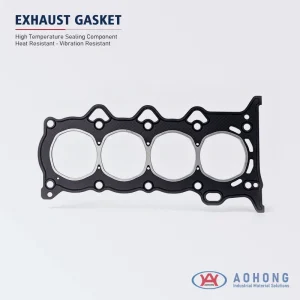
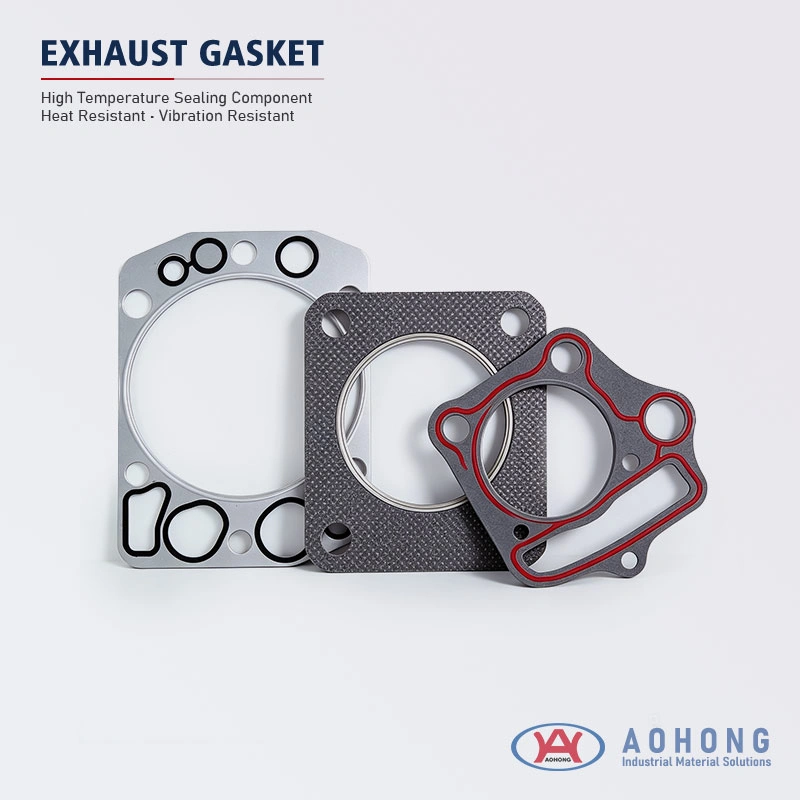
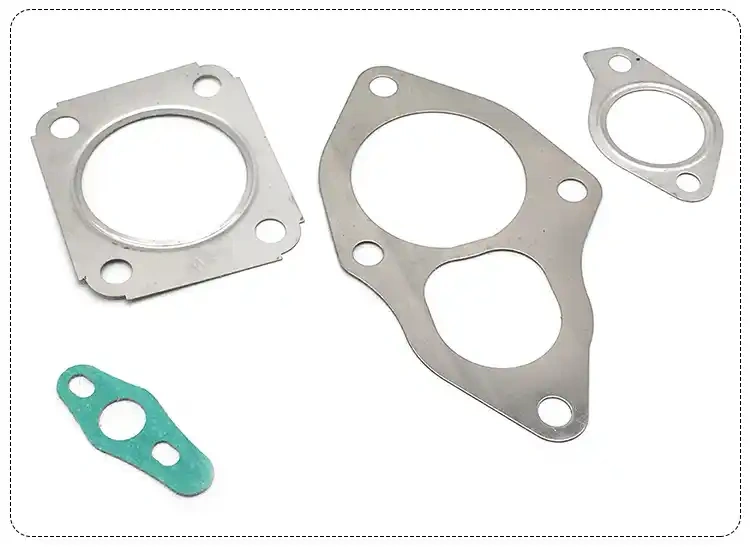
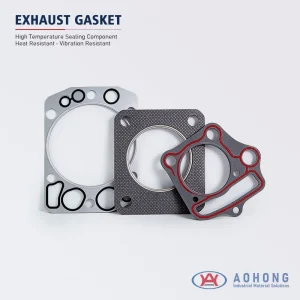
A turbocharger gasket (also called turbo gasket, turbo flange gasket, header gasket or exhaust turbo gasket) seals the junctions between turbocharger inlet/outlet flanges, manifold-to-turbo faces and downpipe flanges. Designed for extreme thermal cycling and vibration, turbo gaskets are available in Multi-Layer Steel (MLS), copper, stamped steel and graphite-composite constructions to match turbo duty and flange type.
Materials & common constructions
Common constructions:
-
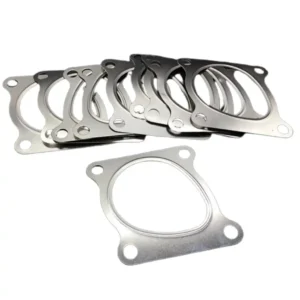
Multi-Layer Steel (MLS): multiple stainless steel layers with embossed corrugations or beads — excellent for high-temperature cycling and repeatable sealing on smooth flange faces.
-
Copper (solid or embossed): soft, re-formable copper gaskets (often annealed) that conform to rough flanges and tolerate extreme peak EGTs — popular in high-performance/turbo race builds.
-
Graphite / Graphite-Composite: graphite or composite faces bonded to metal cores for high-temperature conductivity and good conformity on imperfect flanges.
-
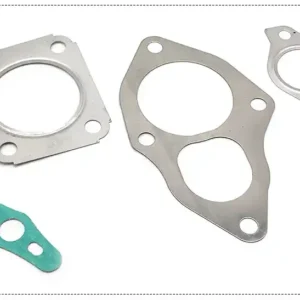
Stamped / Embossed Stainless: pressed stainless gaskets for standard turbo flanges (fast, low-cost, durable).
Why material matters: choose MLS or copper where very high EGTs, repeated cycles and strong bolt loads are expected; choose graphite-composite where flange faces are uneven and conformability is required.
Typical temperature & performance guidance
-
Operating temperature: turbocharger exhaust components commonly see 200°C – 800°C in normal operation, with intermittent peaks above 900°C in aggressive/tuned engines; material choice must match these extremes.
-
Thermal cycling: turbo gaskets must survive rapid cycles from ambient to EGTs in minutes — MLS and copper perform especially well under such cycling when installed on correct flange finishes.
- Material: Stainless Steel.
Most turbo systems use one of several standard flange types — select a gasket that matches the flange geometry (bolt pattern, port ID, bolt circle).
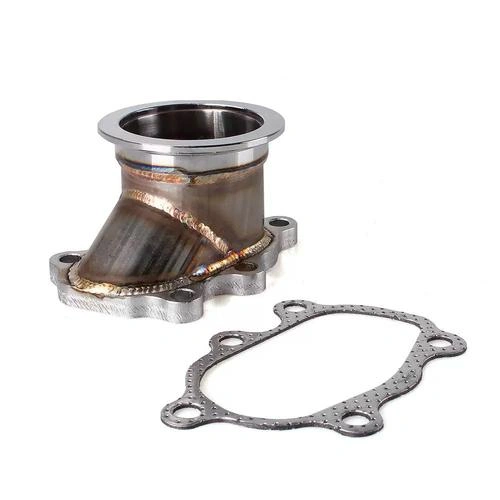
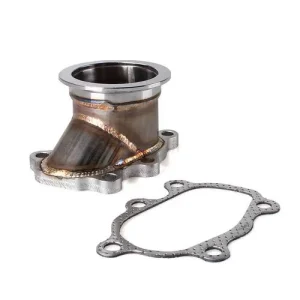
Common turbo flange types: T2, T3, T4, T6, 2-bolt 2.5″ (63.5 mm) / 3″ (76.2 mm) flanges, and V-band clamps (with V-band gaskets). See flange-type identification guides and CNC templates when ordering.
Representative common gasket/bore examples (use as starting points — always confirm with flange drawing):
| Flange type | Typical inner port / bore | Typical outer span / bolt centers |
|---|---|---|
| 2-bolt turbo flange (2.5″) | 63.5 mm (2.5″) ID common | bolt center to center ≈ 97 mm (varies by spec). |
| T3 inlet flange | port ~70–80 mm (varies by manufacturer) | 4-bolt pattern per T3 spec. |
| T4 inlet flange | larger port ~80–95 mm | 4-bolt/T4 bolt pattern. |
| V-band (clamp) gasket | ring-type gasket to match V-band ID | available in standard sizes for 1.5″–4″ and above. |
For production and quoting, provide the exact flange drawing (bolt circle, bolt hole diameter, center-to-center) or the OEM part number — that avoids costly mismatches.
Specifications / stock & custom options
Typical stock thicknesses:
-
MLS: 0.5 mm, 0.8 mm, 1.0 mm, 1.2 mm.
-
Copper: typically 0.8–1.2 mm (annealed working thickness varies).
-
Graphite/composite: 1.0 mm, 1.5 mm, 2.0 mm, 3.0 mm.
Ordering checklist (supply these to get an accurate quote): flange type (T3/T4/2-bolt/V-band), NPS or port ID, bolt circle / PCD, bolt hole diameter, gasket thickness, material preference (MLS/copper/graphite), surface finish requirement, and any special coatings (silicone/high-temp coatings, anti-seize).
 Key advantages
-
Engineered for extreme EGTs and rapid thermal cycles.
-
Durable sealing under vibration and pulse loading (MLS & copper excel).
-
Custom CNC cutting to exact flange drawings reduces fitment failures and leakage callbacks.
-
Wide material options let you balance cost, durability and flange condition.
-
V-band gasket options available for clamp-style turbo connections (fast service & quick replacement).
Material comparison table
| Feature | MLS (Multi-Layer Steel) | Copper (annealed) | Graphite/Composite | Stamped SS |
|---|---|---|---|---|
| Peak temp endurance | High (good to ~700°C+) | Very high (can handle peaks >900°C short term) | High (graphite can tolerate very high T but oxidation risk in air) | Moderate to high |
| Conformability to rough faces | Low (needs smooth faces) | High (can be reformed) | High (excellent conformity) | Moderate |
| Repeatable sealing after cycles | Excellent | Good (may need re-anneal for reuse) | Good | Good |
| Best use | OE & turbo with smooth machined flanges | Motorsport / extreme EGT / custom flanges | Retrofit or uneven flanges | OEM OEM style flanges & budget replacement |
| (Use the comparison to pick the correct gasket for flange finish, expected EGT and service life.) |
Turbo-specific installation & best practices
-
Match flange finish: MLS requires smooth, flat finish — measure flange runout and surface roughness before choosing MLS. If faces are pitted, use copper or graphite composite.
-
Torque & fastener practice: use proper grade bolts/studs and torque sequence — follow OEM or gasket-maker torque charts. Avoid “max-out” overtightening that can distort flanges.
-
Heat management: insulation blankets and heat shields can reduce flange oxidation risk and prolong gasket life — important for graphite-type gaskets.
-
V-band clamps: ensure correct gasket type (ring style V-band gasket) to prevent clamp slippage under thermal cycles.
Common failure modes & how to avoid them
-
Blow-out / leaks: caused by insufficient clamp load or wrong gasket material — avoid by using correct gasket type and torque.
-
Creep & cold-flow (graphite): select reinforced or thicker constructions for persistent creep conditions.
-
Oxidation of graphite in air at very high T: use impregnated graphite or choose copper/MLS where oxidizing peaks are expected.
Frequently Asked Questions (FAQ)
Q1 — What are common aliases for this product?
A: Turbocharger gasket, turbo gasket, turbo flange gasket, header gasket, turbo exhaust gasket.
Q2 — Which gasket is best for turbocharged street cars?
A: For most street turbo setups, MLS or graphite-composite are popular (MLS if flanges are machined & smooth; graphite if flanges are imperfect). Copper is preferred for high EGT race use.
Q3 — How do I know the right gasket size?
A: Provide the flange drawing (PCD, bolt hole dia, port ID) or OEM turbo part number. Common off-the-shelf sizes include 2-bolt 2.5″ (63.5 mm) and various T3/T4 patterns — but always confirm with the actual flange.
Q4 — Can I reuse a turbo gasket?
A: Most gaskets deform during first use and should be replaced; copper can sometimes be reformed but replacement is recommended for reliability.
Q5 — Do you supply V-band gaskets?
A: Yes — ring style gaskets for V-band clamps are available in standard sizes for 1.5″–4″ and larger, and can be supplied in stainless or coated graphite options.